Croque monsieur
Victorian / Belle Époque
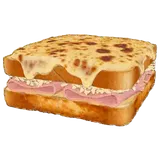
Croque monsieur
3 places claim to have invented this one. The case file is below.
High confidenceAnatomy of the Croque monsieur
Origin story
Paris, France · 48.87°N, 2.33°E
Usually dated to 1910, when it appeared on the menu of a café on the Boulevard des Capucines, and that is the date everyone repeats.
Usually dated to 1910, when it appeared on the menu of a café on the Boulevard des Capucines, and that is the date everyone repeats. It is also demonstrably too late. La Revue Athlétique mentions croque-monsieur in 1891, and Proust refers to it in a letter to his mother in the 1890s. So the 1910 menu is not the sandwich's birth, it is the moment it became respectable enough to print.
1891
A mention in La Revue Athlétique: predating the celebrated 1910 café menu by nearly two decades [1]
The Dispute
We don't adjudicate. Here is the evidence for each claim, neutrally, with its source.
Usually dated to 1910, when it appeared on the menu of a café on the Boulevard des Capucines, and that is the date everyone repeats. It is also demonstrably too late. La Revue Athlétique mentions croque-monsieur in 1891, and Proust refers to it in a letter to his mother in the 1890s. So the 1910 menu is not the sandwich's birth, it is the moment it became respectable enough to print.
Boulevard des Capucines, Paris
The popular account gives a café on the Boulevard des Capucines in 1910 as the first appearance. The 1891 and 1890s references make this a milestone rather than an origin.
Evidence: [2]
Unnamed claim
Its best-known literary appearance is in the second volume of Proust's À la recherche du temps perdu, 1918, often miscited as the earliest reference when it is merely the most famous.
Evidence: [1]
Our reconstruction
Notes on this reconstruction
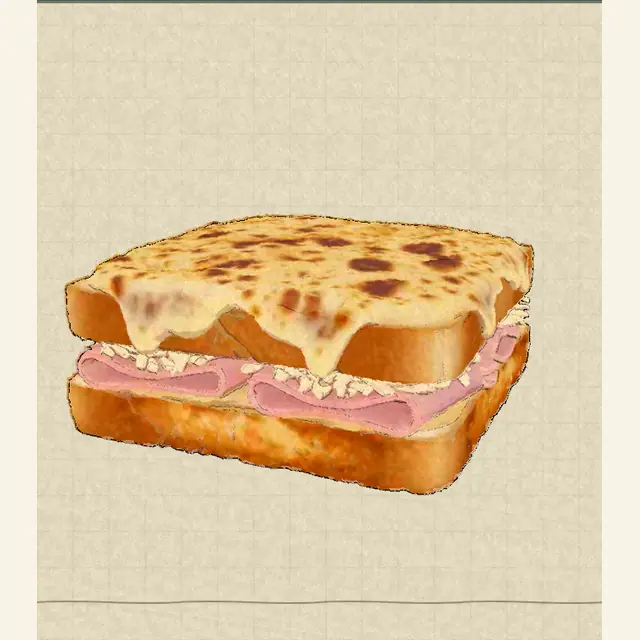
The validator flags this record for holding disputed claims while keeping confidence "high": deliberate. The dispute here is about the date, not the construction: nobody disagrees about what a croque monsieur is. Confidence describes the recipe, not the history. The argument worth having is béchamel or no béchamel. The austere version is just ham, cheese and butter, griddled; the version served across Paris today is bound with béchamel and gratinéed. We give the béchamel build because it is what the name now means to almost everyone who orders one, and we are flagging that this is a choice, not a finding. Put a fried egg on it and it becomes a croque madame: same sandwich, different honorific.
- Yield
- 2 sandwiches
Method
Make the béchamel: melt the butter, stir in the flour and cook the raw taste out for two minutes without colouring it. Add the milk a little at a time, whisking, until smooth and thick enough to coat a spoon.
Take it off the heat and stir in the mustard, nutmeg, seasoning and a third of the cheese.
Lightly toast the bread on both sides: this is insurance against a sodden middle.
Spread béchamel on two slices, add ham, a little more cheese, and close with the remaining slices.
Spoon the rest of the béchamel over the tops, right to the edges, and blanket with the remaining cheese.
Grill under a high heat until blistered and brown in patches, about 5 minutes. Watch it: it goes from golden to bitter in under a minute.
Rest briefly so the béchamel sets enough to cut. For a croque madame, top each with a fried egg.
Sources
- Croque monsieur: Wikipedia (retrieved 2026-09-22) 1910 Boulevard des Capucines menu; 1891 La Revue Athlétique; Proust's 1890s letter; 1918 À la recherche du temps perdu
- What a croque: Parisian Fields (retrieved 2026-09-22) Argues explicitly that 1910 is too late given the earlier references