Cuban sandwich
Victorian / Belle Époque
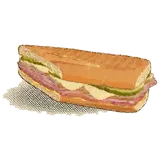
Cuban sandwich (Sándwich cubano)
Also known as Cubano, Sandwich mixto
3 places claim to have invented this one. The case file is below.
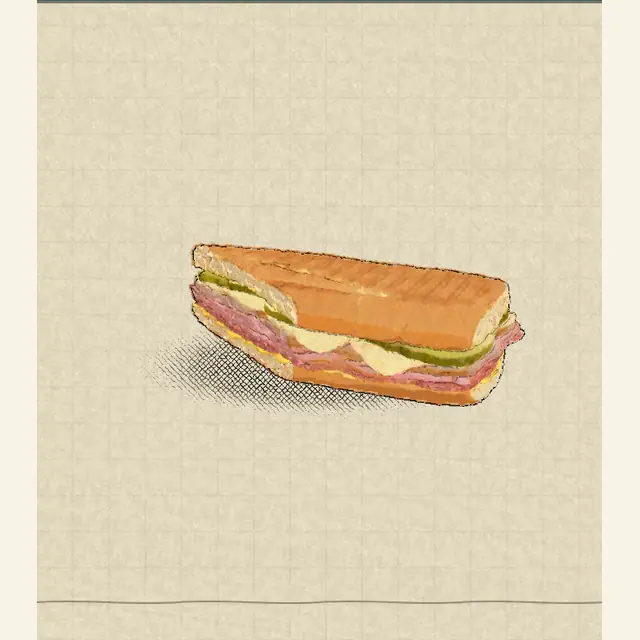
Medium confidenceAnatomy of the Cuban sandwich
Origin story
Havana, Cuba, then Ybor City, Tampa, Florida, Cuba / United States · 23.11°N, 82.37°W
The ancestor is Cuban: a sandwich mixto of roast pork, ham, pickles, cheese and mustard on Cuban bread, on Havana menus in the 1800s.
The ancestor is Cuban: a sandwich mixto of roast pork, ham, pickles, cheese and mustard on Cuban bread, on Havana menus in the 1800s. The sandwich then travelled with cigar workers to Key West and on to Ybor City and West Tampa, where the earliest recorded descriptions of a distinct Cuban sandwich appear in workers' cafés around 1900. Tampa's version picked up Genoa salami from the Italians it was living alongside, which is why the Tampa-versus-Miami argument is really an argument about salami.
1900
Descriptions of the sandwich in workers' cafés in Ybor City and West Tampa: the earliest recorded mentions of a distinct Cuban sandwich [1]
The Dispute
We don't adjudicate. Here is the evidence for each claim, neutrally, with its source.
The ancestor is Cuban: a sandwich mixto of roast pork, ham, pickles, cheese and mustard on Cuban bread, on Havana menus in the 1800s. The sandwich then travelled with cigar workers to Key West and on to Ybor City and West Tampa, where the earliest recorded descriptions of a distinct Cuban sandwich appear in workers' cafés around 1900. Tampa's version picked up Genoa salami from the Italians it was living alongside, which is why the Tampa-versus-Miami argument is really an argument about salami.
Ybor City, Tampa, Florida, USA
Tampa claims it as its own and adds Genoa salami, a legacy of Ybor City's Italian community.
Evidence: [2]
Miami, Florida, USA
Miami claims it too, with a version that omits the salami. Miami's rose with the Cuban community that formed after 1959, which makes it the youngest of the three claims, not the oldest.
Evidence: [2]
Our reconstruction
Notes on this reconstruction
We give the Tampa build, salami included, because the earliest recorded descriptions of a *distinct* Cuban sandwich are the Ybor City ones. Leave the salami out and you have the Miami version. Both are legitimate and we are not refereeing. Cuban bread matters more than anything in the filling: it is a lard-enriched loaf with a thin, shattering crust, and a baguette is not a substitute so much as a different sandwich.
- Yield
- 1 sandwich
Method
Split the bread lengthways without cutting all the way through, and spread mustard across the bottom face only.
Layer in order: salami, ham, roast pork, cheese, then the pickles on top. Cheese under the pickles keeps the bread from going soft.
Butter the outside of the loaf, top and bottom.
Press in a hot sandwich press, or in a dry pan under a heavy weight, until the loaf is compressed to roughly a third of its height and the crust is crisp and marked.
Give it 6 to 8 minutes, long enough for the cheese to bind the layers into one thing. Undercooked, it falls apart in the hand.
Cut on a sharp diagonal and eat hot.
Sources
- What's the origin of the Cuban sandwich? Researchers set out to settle the debate: NPR (retrieved 2026-09-22) Havana menus in the 1800s; Key West and Ybor City transmission
- Cuban sandwich: Wikipedia (retrieved 2026-09-22) c.1900 Ybor City / West Tampa records; Genoa salami; Miami post-1959
- Unraveling the Story of the Cuban Sandwich: La Segunda Bakery (retrieved 2026-09-22) Cuban bread; Tampa bakery perspective