Mitraillette
Time Immemorial
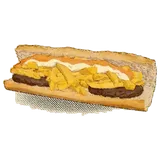
Mitraillette
Also known as Américain, Spécial, Pain-frites, Routier
3 places claim to have invented this one. The case file is below.
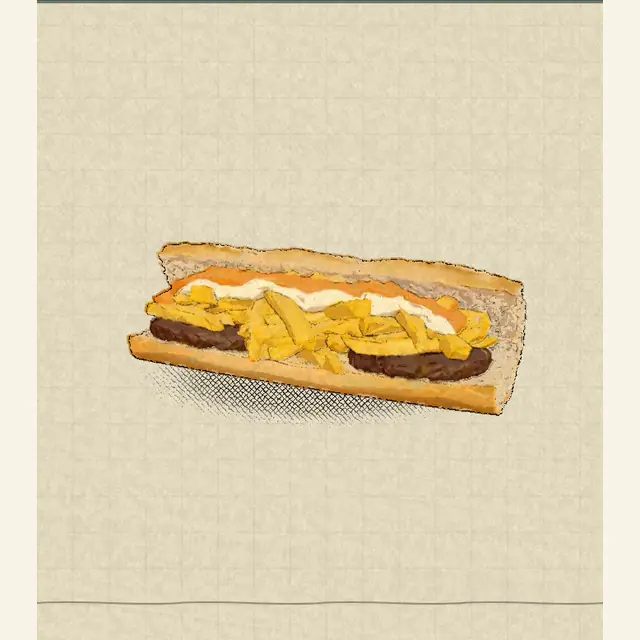
Medium confidenceAnatomy of the Mitraillette
Origin story
Charleroi, Hainaut, Belgium · 50.41°N, 4.44°E
Focus on Belgium, a Belgian site of national facts and explainers, says the mitraillette came out of the Charleroi region of Wallonia in the inter-war period, when people short of money (and soldiers short of rations)…
Focus on Belgium, a Belgian site of national facts and explainers, says the mitraillette came out of the Charleroi region of Wallonia in the inter-war period, when people short of money (and soldiers short of rations) made a meal of bread with a few fries in it. It names the Charleroi chip shop Robert la frite, open since 1952, as its authority on the subject. The same account says the sandwich only took its current shape once French-style baguettes were being baked in Belgium, around 1975 and 1976. None of this rests on a dated document: no inventor is named, and we found no earliest written reference. The name is French for submachine gun, and the usual explanation is that the long loaf is the barrel and the fries are the ammunition, though Focus on Belgium itself presents that as one hypothesis among several.
No earliest documentary reference found, so the record is open. If you have one, that's worth more to us than another retelling.
The Dispute
We don't adjudicate. Here is the evidence for each claim, neutrally, with its source.
Focus on Belgium, a Belgian site of national facts and explainers, says the mitraillette came out of the Charleroi region of Wallonia in the inter-war period, when people short of money (and soldiers short of rations) made a meal of bread with a few fries in it. It names the Charleroi chip shop Robert la frite, open since 1952, as its authority on the subject. The same account says the sandwich only took its current shape once French-style baguettes were being baked in Belgium, around 1975 and 1976. None of this rests on a dated document: no inventor is named, and we found no earliest written reference. The name is French for submachine gun, and the usual explanation is that the long loaf is the barrel and the fries are the ammunition, though Focus on Belgium itself presents that as one hypothesis among several.
Brussels, Belgium
Wikipedia says the mitraillette is thought to have originated in Brussels, where it is now a fixture of the city's friteries. It gives no date or source for the Brussels attribution.
Evidence: [1]
Unnamed claim
The Sword and the Sandwich reads the Charleroi and inter-war story as unsourced and repeated from one account to the next, and questions the fifty-year gap it implies between mass-produced baguettes in France and their arrival in Belgium. It finds no evidence that bread and fries were invented by, or confined to, Walloon soldiers.
Evidence: [3]
Our reconstruction
Notes on this reconstruction
The construction is well documented; the original is not, because there is no original recipe, only a format. Every source agrees on half a baguette, a fried friterie meat, fries inside the bread and sauce on top, and every source says the meat is the customer's choice. We use a fried minced-beef burger patty because it is the meat that turns up first in nearly every friterie menu and description we read; a boulette, fricadelle or cervelas is just as correct. Sauce andalouse (mayonnaise with tomato and sweet pepper) is the default because Inside Brussels recommends it to the undecided and it is the one Belgian writers name most; two sauces in one bread is normal. Crudités are optional and often skipped. Archetype is long-roll: it is a split baguette, open along its length.
- Yield
- 1 sandwich
Method
Cut the potatoes into fries about 1 cm thick, rinse off the surface starch and dry them well.
Fry them a first time at around 150 to 160°C until soft right through but still pale, then lift them out and let them rest at least ten minutes.
Fry the patty on a hot griddle or plancha, or in the fat, until well browned on both faces and cooked through.
Give the fries their second bath at about 175 to 180°C until golden and crisp, drain them and salt them straight away.
Slice the half baguette lengthways without cutting through the back, and open it like a trough. Lay in the crudités first if you are using them, then the meat.
Pile the fries in on top of the meat along the whole length, more than the bread can sensibly close over.
Pour the sauce over the fries in a thick line, wrap the lower half in paper and eat it standing up, while the fries are still hot.
Sources
- Mitraillette: Wikipedia (retrieved 2026-10-30) Thought to have originated in Brussels; half baguette, fried meat, fries, sauces; filling hot, bread room temperature or warmed; 'Américain' in the Nord
- Did you know that the mitraillette originated in the inter-war period? Focus on Belgium (retrieved 2026-10-30) Charleroi region, inter-war period; Robert la frite (1952); modern form with Belgian baguettes from 1975-76; regional names
- Notable Sandwiches #118: Mitraillette, The Sword and the Sandwich (retrieved 2026-10-30) Critiques the Charleroi and inter-war account as unsourced
- The Belgian submachine gun, a culinary curiosity to taste in chip shops in Brussels: Inside Brussels (retrieved 2026-10-30) Bread left wide open; fries overflowing onto the tray; meat list; andalouse as default; two sauces common; wrapped in plain paper
- Cette spécialité culinaire belge est la plus calorique: Paris Match Belgique (retrieved 2026-10-30) Half baguette with a friterie snack meat, fries and a large quantity of sauce
- The odd semantics of Belgium's machine-gun mitraillette sandwiches, aka Américains: Capstan (retrieved 2026-10-30) Naming: baguette as gun, fries as bullets; 'américain' in northern France versus the raw-beef spread in Belgium