Jambon-beurre
Time Immemorial
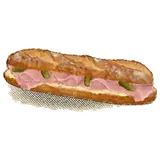
Jambon-beurre
Also known as Parisian sandwich
2 places claim to have invented this one. The case file is below.
High confidenceAnatomy of the Jambon-beurre
Origin story
Paris, France · 48.86°N, 2.35°E
Unlike several of the dishes in this dataset, jambon-beurre has no single inventor, no restaurant of record, and no clean founding date: it is best understood as a practical worker's food that assembled itself over the…
Unlike several of the dishes in this dataset, jambon-beurre has no single inventor, no restaurant of record, and no clean founding date: it is best understood as a practical worker's food that assembled itself over the second half of the nineteenth century around Paris's markets and building sites, where bread, butter and ham were all cheap, required no cooking, and travelled well. The baguette itself was not yet standardised: French loaves only evolved gradually toward the long, thin, crusty shape now assumed, and the word "baguette" itself, applied to bread, is not officially attested until a 1902 patent filing. What sources agree on is the trajectory rather than a moment: workers eating bread with lard or butter through the nineteenth century, ham and the baguette shape converging by the early twentieth, and the sandwich becoming France's default lunch from 1945 onward as the country rebuilt. A 2017 industry study found it accounted for half of all sandwiches sold nationally, which is as close as this dish gets to a documented milestone.
No earliest documentary reference found, so the record is open. If you have one, that's worth more to us than another retelling.
The Dispute
We don't adjudicate. Here is the evidence for each claim, neutrally, with its source.
Paris, France
Unlike several of the dishes in this dataset, jambon-beurre has no single inventor, no restaurant of record, and no clean founding date: it is best understood as a practical worker's food that assembled itself over the second half of the nineteenth century around Paris's markets and building sites, where bread, butter and ham were all cheap, required no cooking, and travelled well. The baguette itself was not yet standardised: French loaves only evolved gradually toward the long, thin, crusty shape now assumed, and the word "baguette" itself, applied to bread, is not officially attested until a 1902 patent filing. What sources agree on is the trajectory rather than a moment: workers eating bread with lard or butter through the nineteenth century, ham and the baguette shape converging by the early twentieth, and the sandwich becoming France's default lunch from 1945 onward as the country rebuilt. A 2017 industry study found it accounted for half of all sandwiches sold nationally, which is as close as this dish gets to a documented milestone.
Evidence: [2]
Unnamed claim
Some accounts place the sandwich's popularisation specifically on Parisian construction sites and Les Halles market stalls in the nineteenth century; others treat it as a more general, undated evolution of worker's bread-and-fat rations with no single site of origin. Neither account names a first seller or a first date.
Evidence: [2]
Our reconstruction
Notes on this reconstruction
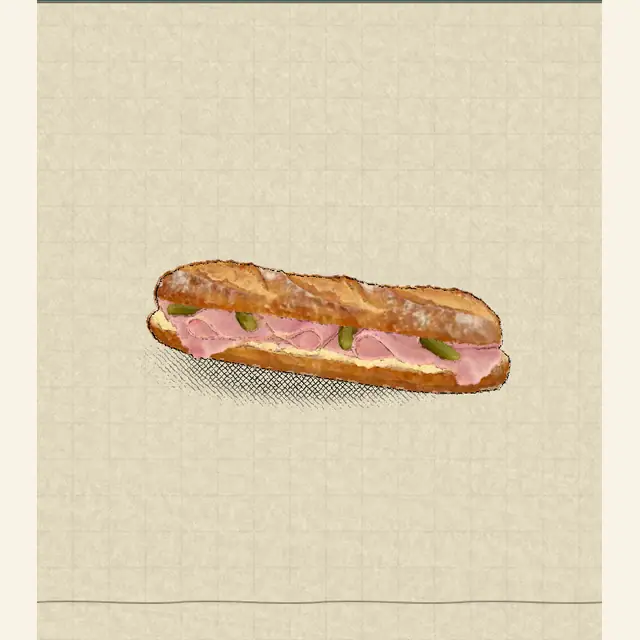
Confidence is high because, unlike the origin date, the construction has never really been in dispute: baguette, butter, ham, nothing else, in that order of importance. The quality of each of the three ingredients is doing all the work here, so we call for jambon de Paris specifically rather than any cooked ham, and a butter with enough salt to read as a seasoning rather than a lubricant. Cornichons are a common but non-essential addition; we treat them as optional because the classic three-ingredient version is still what most French people mean by the name.
- Yield
- 1 sandwich
Method
Split the baguette lengthways, keeping a hinge along one side rather than cutting all the way through.
Spread the butter thickly and evenly across both cut faces, right to the ends: this is the sandwich's only real seasoning, so do not skimp.
Fold the ham slices rather than laying them flat, so the sandwich has some volume rather than sitting sheet-flat inside the bread.
Add cornichons along one side if using.
Close the baguette and press down gently just enough to bring the two faces together without crushing the crumb.
Eat within the hour: the crust is a structural ingredient here, and it does not survive long once it is closed around the filling.
Sources
- Jambon-beurre: Wikipedia (retrieved 2026-09-24) Baguette, butter, ham composition; roughly three million sold daily in France
- History of the ham-and-butter or "Parisian" sandwich: La Route des Gourmets (retrieved 2026-09-24) Gradual baguette-shape evolution; workers' bread-and-fat rations on Parisian building sites; sandwich's rise from 1945; 2017 study finding it as half of all sandwiches sold in France
- Jambon-Beurre - Traditional Parisian Recipe: 196 flavors (retrieved 2026-09-24) 1902 patent as the first official attestation of the word "baguette" applied to bread; class differences in who ate baguette sandwiches vs English-style triangle sandwiches