Hamburger
Victorian / Belle Époque
Hamburger
4 places claim to have invented this one. The case file is below.
ContestedAnatomy of the Hamburger
Origin story
New Haven, Connecticut, USA · 41.31°N, 72.93°W
No single origin survives scrutiny.
No single origin survives scrutiny. The best-documented American claim belongs to Louis' Lunch in New Haven, which says it served a ground-beef patty between two slices of toast in 1900 to a customer in a hurry; the Library of Congress recognised the claim in 2000. What is certain is older and less tidy: Hamburg-style chopped beef steak travelled to the United States with German emigrants in the nineteenth century, and several people independently put it in bread once fairs and lunch counters made portability matter.
1900
Louis' Lunch, New Haven: the claim recognised by the Library of Congress in 2000, though the recognition rests on the restaurant's own account rather than contemporary documentation [1]
The Dispute
We don't adjudicate. Here is the evidence for each claim, neutrally, with its source.
No single origin survives scrutiny. The best-documented American claim belongs to Louis' Lunch in New Haven, which says it served a ground-beef patty between two slices of toast in 1900 to a customer in a hurry; the Library of Congress recognised the claim in 2000. What is certain is older and less tidy: Hamburg-style chopped beef steak travelled to the United States with German emigrants in the nineteenth century, and several people independently put it in bread once fairs and lunch counters made portability matter.
Seymour, Wisconsin, USA
Charlie Nagreen, aged 15, flattened his meatballs between two slices of bread at the Outagamie County Fair in 1885 so fairgoers could walk with them. Seymour still calls itself the home of the hamburger.
Evidence: [2]
Athens, Texas, USA
Fletcher 'Uncle Fletch' Davis is said to have sold them from an Athens stand, with the town pooling funds to send him to the 1904 St Louis World's Fair. Reporting notes the archival evidence for this is thin.
Evidence: [2]
Unnamed claim
Frank and Charles Menches, and separately Oscar Weber Bilby, are also credited in accounts of the period.
Evidence: [3]
Our reconstruction
Notes on this reconstruction
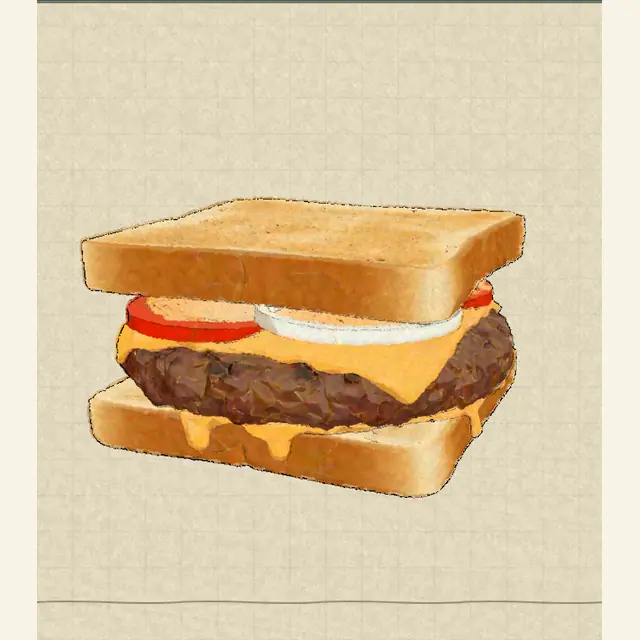
We reconstruct the Louis' Lunch version rather than the modern bun-based burger, because it is the one attached to a documented claim. It is deliberately austere: vertical broiler, white toast instead of a bun, and no ketchup: the shop still refuses it. If you want a modern burger this is not that, and the difference is the point.
- Yield
- 1 sandwich
Method
Form the beef into a thick oval patty, a little longer than it is wide, and season it on both sides. Handle it as little as you can get away with.
Cook it upright if you can: the original is broiled in a vertical cast-iron grill so both faces sear at once and the fat drips clear. A very hot grill pan, turned once, gets you close.
Cook to a deep crust outside and still pink within, about 3 minutes a side for this thickness.
Toast the bread until dry and firm enough to hold the patty without going limp.
Spread the cheese on the hot patty so it slumps, then close the sandwich with tomato and onion if you are using them.
Serve immediately, and do not reach for ketchup: the shop that makes the claim has never allowed it.
Sources
- Louis' Lunch: Wikipedia (retrieved 2026-09-22) 1900 claim; Library of Congress recognition in 2000
- These US cities claim to be 'home of the hamburger.' History supports one by a thin margin (retrieved 2026-09-22) Nagreen 1885; notes thin archival evidence for the Athens claim
- Hamburger: Wikipedia (retrieved 2026-09-22) Menches brothers, Oscar Weber Bilby, Fletcher Davis