Pork chop bun
Time Immemorial

Pork chop bun (豬扒包)
Also known as Jyu pa bau, Chu pa pao, Zhubabao, Macau pork chop bun, Bifana de Macau
3 places claim to have invented this one. The case file is below.
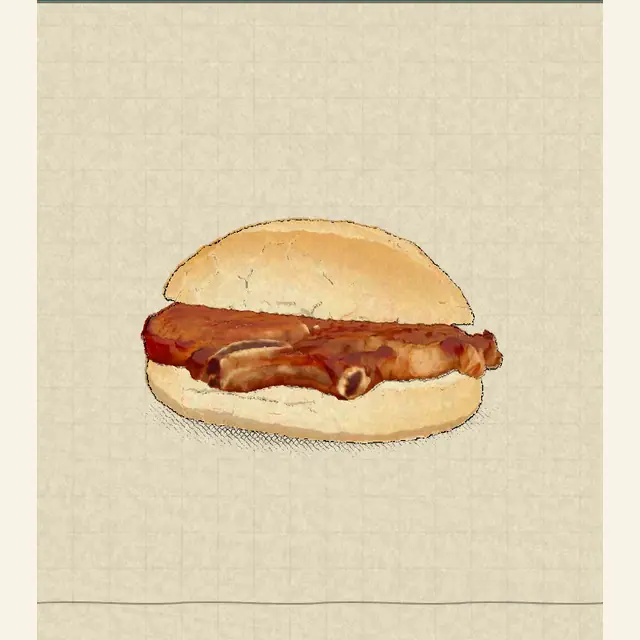
Medium confidenceAnatomy of the Pork chop bun
Origin story
Taipa Village, Macau, Macau SAR, China · 22.15°N, 113.56°E
The pork chop bun is credited to Tai Lei Loi Kei, a shop in Taipa that opened in 1968 baking steamed buns and Chinese pastries.
The pork chop bun is credited to Tai Lei Loi Kei, a shop in Taipa that opened in 1968 baking steamed buns and Chinese pastries. In the 1960s it also baked the plain crusty rolls the Islands municipal council handed out free to poor Taipa residents. The usual account is that customers from the colonial administration nearby suggested putting a marinated pork chop inside those rolls, in the manner of the Portuguese bifana, and the shop's version became the benchmark the rest of Macau is measured against. We found no dated record of the first pork chop bun; 1968 is the founding of the shop, not of the sandwich, and Taipa Village's own directory says Tai Lei Loi Kei has been selling it there since the 1990s. Anthony Bourdain's 2011 visit made it internationally famous, and in November 2025 Macau's Cultural Affairs Bureau announced the craft of making it would join the territory's Inventory of Intangible Cultural Heritage.
No earliest documentary reference found, so the record is open. If you have one, that's worth more to us than another retelling.
The Dispute
We don't adjudicate. Here is the evidence for each claim, neutrally, with its source.
The pork chop bun is credited to Tai Lei Loi Kei, a shop in Taipa that opened in 1968 baking steamed buns and Chinese pastries. In the 1960s it also baked the plain crusty rolls the Islands municipal council handed out free to poor Taipa residents. The usual account is that customers from the colonial administration nearby suggested putting a marinated pork chop inside those rolls, in the manner of the Portuguese bifana, and the shop's version became the benchmark the rest of Macau is measured against. We found no dated record of the first pork chop bun; 1968 is the founding of the shop, not of the sandwich, and Taipa Village's own directory says Tai Lei Loi Kei has been selling it there since the 1990s. Anthony Bourdain's 2011 visit made it internationally famous, and in November 2025 Macau's Cultural Affairs Bureau announced the craft of making it would join the territory's Inventory of Intangible Cultural Heritage.
Taipa Village, Macau
Accounts disagree over who made the suggestion. Directo al Paladar says it was Portuguese government officials from a nearby building; Our China Story says a Macanese (土生葡人) customer proposed it and taught the owner to marinate the pork with bay leaf, in the 1970s when workers building the bridge to Taipa were eating at the shop.
Evidence: [3]
Unnamed claim
Accounts disagree on the date. Wikipedia places the bun in the mid-twentieth century, Our China Story in the 1970s, and the Taipa Village directory dates Tai Lei Loi Kei's pork chop buns in Taipa to the 1990s.
Evidence: [4]
Our reconstruction
Notes on this reconstruction
We build the Tai Lei Loi Kei version because it is the one every source treats as the reference: a bone-in chop, pounded, marinated and fried, in a crusty white roll, with nothing else in it. No lettuce, no sauce, no butter: one long-time visitor's account of the shop is explicit that there are no fillers at all. The bone stays in; Directo al Paladar notes that boneless versions made to suit Western tastes are seen locally as a serious departure. Shops differ on two points we are choosing past: some rivals charcoal-grill the chop rather than fry it, and some offer it in a pineapple bun (菠蘿包), which is an option on the menu rather than the default. The marinade is ours, assembled from the components the sources list (bay leaf, garlic, soy, Shaoxing wine, five-spice, sugar, white pepper, bicarbonate); no shop publishes its own. Archetype is round-bun: the roll is a short oval split horizontally, which our round-bun mesh renders closest.
- Yield
- 4 buns
Method
Snip through the fat and connective tissue at the edge of each chop in two or three places so it does not curl, then beat the meat hard with the back of a cleaver or a mallet until it spreads and thins, leaving the bone in.
Mix the soy, wine, garlic, bay, five-spice, sugar, pepper and bicarbonate, and work it into the chops. Leave them for at least two hours in the fridge, or overnight.
Shake off the excess marinade and dust each chop thinly with cornflour.
Shallow fry in hot oil, turning once, until the outside is a deep glossy brown and the meat is just cooked, about three minutes a side.
While the chops rest, warm the rolls in a hot oven for a few minutes so the crust crisps again.
Split each roll horizontally, keeping a hinge, and lay a whole chop inside, bone and all. Let it hang out past the edge rather than trimming it.
Add nothing else. Bag it in brown paper and eat it straight away, holding the bone end.
Sources
- Pork chop bun: Wikipedia (retrieved 2026-10-30) Macau specialty; mid-twentieth century; Tai Lei Loi Kei (1968); piggy bun crisp outside, soft inside; Chinese name 豬扒包
- Cafe Tai Lei Loi Kei: Taipa Village Macau directory (retrieved 2026-10-30) Free council buns in the 1960s; pork chop bun in Taipa since the 1990s; thick marinated fried chop in toasted Portuguese buns; baked daily at 2 pm; Rua Correia da Silva 35
- Nació en Portugal, enamoró a Anthony Bourdain: Directo al Paladar (retrieved 2026-10-30) 1968 founding; Portuguese officials' suggestion; thick bone-in chop; marinade components; charcoal-grilled rival; pineapple bun option; Bourdain 2011
- 世界美食之都:以「二次創作」菜式享譽國際的澳門: Our China Story (retrieved 2026-10-30) 1970s bridge workers; relief buns from council flour; Macanese customer's suggestion and bay-leaf marinade; chop pounded with a mallet
- Tai Lei Loi Kei, Macau: Eat Travel Eat (retrieved 2026-10-30) Bone-in chop; white bun lightly crisp outside; no lettuce, pickles or cheese; handed over in a brown paper bag
- Macau Cultural Affairs Bureau to list Pork Chop Bun on Inventory of Intangible Cultural Heritage: Macau Post Daily (retrieved 2026-10-30) 13 November 2025 announcement covering the craft of making pork chop buns