Roujiamo
Time Immemorial
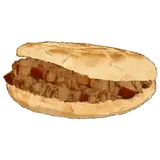
Roujiamo (肉夹馍)
Also known as Rou jia mo, Chinese hamburger
2 places claim to have invented this one. The case file is below.
Medium confidenceAnatomy of the Roujiamo
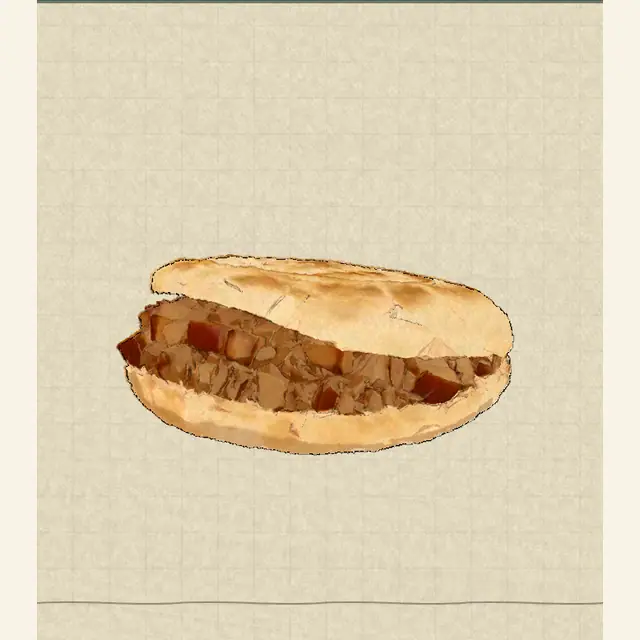
Origin story
Xi'an, Shaanxi, China · 34.34°N, 108.94°E
Roujiamo, literally 'meat folded into bread', is a Shaanxi dish, and Xi'an is consistently named as its home.
Roujiamo, literally 'meat folded into bread', is a Shaanxi dish, and Xi'an is consistently named as its home. Its two halves have different, much older lineages that Chinese food writing treats as genuinely old rather than recent inventions: baijimo, the dense wheat flatbread that's split and stuffed, is associated with bread-making traditions reaching back to the Qin dynasty (221–206 BCE), while the long-braised, heavily spiced meat filling is linked to meat-preparation methods from the Zhou dynasty (1045–256 BCE). The specific combination now eaten as roujiamo is usually described as having taken its modern form during the Ming and Qing dynasties. We have not found a single dated 'first roujiamo': what's documented is layered across centuries rather than pinned to one year, so we say that plainly rather than inventing a date. In 2016 it was recognised as Shaanxi Province Intangible Cultural Heritage, which is a modern marker, not an origin date.
No earliest documentary reference found, so the record is open. If you have one, that's worth more to us than another retelling.
The Dispute
We don't adjudicate. Here is the evidence for each claim, neutrally, with its source.
Xi'an, Shaanxi, China
Roujiamo, literally 'meat folded into bread', is a Shaanxi dish, and Xi'an is consistently named as its home. Its two halves have different, much older lineages that Chinese food writing treats as genuinely old rather than recent inventions: baijimo, the dense wheat flatbread that's split and stuffed, is associated with bread-making traditions reaching back to the Qin dynasty (221–206 BCE), while the long-braised, heavily spiced meat filling is linked to meat-preparation methods from the Zhou dynasty (1045–256 BCE). The specific combination now eaten as roujiamo is usually described as having taken its modern form during the Ming and Qing dynasties. We have not found a single dated 'first roujiamo': what's documented is layered across centuries rather than pinned to one year, so we say that plainly rather than inventing a date. In 2016 it was recognised as Shaanxi Province Intangible Cultural Heritage, which is a modern marker, not an origin date.
Evidence: [2]
Unnamed claim
Some Western-facing food coverage markets roujiamo as 'the world's first hamburger,' pointing to bread-and-meat combinations reaching back roughly two thousand years. Goldthread, covering the dish itself, pushes back on the 'first' framing directly, noting that people have combined meat and bread independently in many food cultures and that a genuine 'first' is unrecoverable: what's well supported is that roujiamo is old and distinctively Xi'an, not that it predates every other stuffed bread on earth.
Evidence: [2]
Our reconstruction
Notes on this reconstruction
Pork is the default filling across most of Xi'an; in the city's Hui Muslim quarter, beef or lamb replaces it, seasoned with cumin, the version most associated with the 'Xi'an' name outside China. We give the Han-Chinese pork baseline here and treat the beef version as an equally traditional variant to record separately, not a substitute for this one. The three-leavener bun dough (yeast, baking powder and baking soda together) is a widely used modern trick for a fluffier crumb; older versions likely relied on yeast or a sourdough starter alone, which is worth naming as a deviation rather than passing off as ancient practice.
- Yield
- 4 buns
Method
Blanch the pork briefly to remove scum, then rinse.
Melt the rock sugar in a little oil until it turns amber, add the pork and coat it in the caramel.
Add ginger, scallion, the spices, both soy sauces and the wine, cover with water, and simmer very gently for about 90 minutes until the meat is soft enough to fall apart with chopsticks.
Meanwhile, make the dough with flour, yeast, baking powder, baking soda, salt and warm water; knead until smooth, then rest, covered, for an hour.
Divide the dough, roll each piece into a rope, coil it, then flatten into a thick disc.
Cook the discs on a dry, hot griddle until lightly spotted, then finish in a hot oven for a few minutes until they puff and the crust sets firm.
Split each bun most of the way through without separating the halves.
Lift the braised pork from its liquid, chop it roughly with a cleaver until the fat and lean meat are evenly mixed, and stuff it generously into the warm bun.
Sources
- Roujiamo: Wikipedia (retrieved 2026-09-24) Name meaning; Qin-dynasty mo, Zhou-dynasty meat prep; modern form dated to Ming/Qing; 2016 Intangible Cultural Heritage listing
- Roujiamo: Is this Chinese snack the world's first hamburger?, Goldthread (retrieved 2026-09-24) Pushes back on the 'world's first hamburger' framing as unprovable
- Xi'an Chinese Hamburger (Roujiamo 西安肉夹馍): The Mala Market (retrieved 2026-09-24) Braising ingredients and Tongguan-style bun dough, used as ingredient reference