Fricassé
Time Immemorial
Fricassé (فريكاسي)
Also known as fricasse, Tunisian fricassé, fricassée tunisienne
2 places claim to have invented this one. The case file is below.
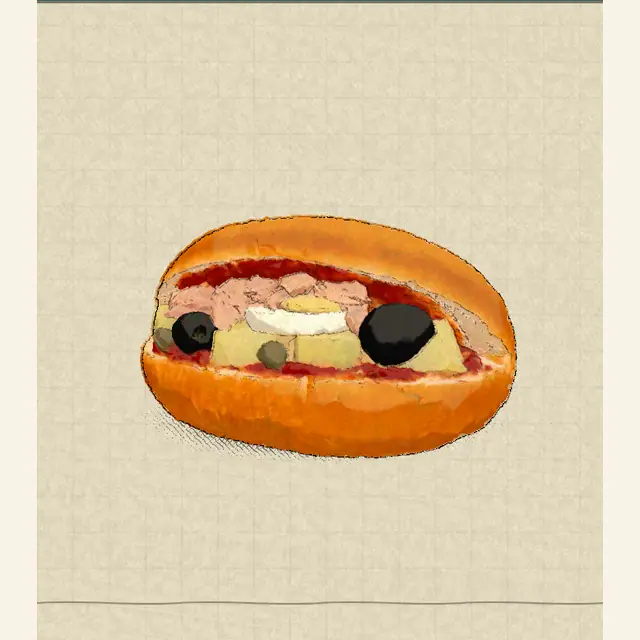
Medium confidenceAnatomy of the Fricassé
Origin story
La Goulette, Tunis, Tunisia · 36.82°N, 10.30°E
The story Tunisians tell places it in a Jewish family in La Goulette, the port suburb north of Tunis.
The story Tunisians tell places it in a Jewish family in La Goulette, the port suburb north of Tunis. A grandmother had made a large batch of dough for sweet fritters for guests who never arrived; rather than face a mountain of sweets, she fried them anyway, split them open and stuffed them with what was in the kitchen (tuna, boiled egg, potato, olives, harissa) and passed them round the neighbours. The name is usually read as French, 'frit' plus 'cassé', fried and then broken open. It is an oral account: we found no dated written reference for the first fricassé. Tunisian Jewish emigration later carried it to Israel and France.
No earliest documentary reference found, so the record is open. If you have one, that's worth more to us than another retelling.
The Dispute
We don't adjudicate. Here is the evidence for each claim, neutrally, with its source.
La Goulette, Tunis, Tunisia
The story Tunisians tell places it in a Jewish family in La Goulette, the port suburb north of Tunis. A grandmother had made a large batch of dough for sweet fritters for guests who never arrived; rather than face a mountain of sweets, she fried them anyway, split them open and stuffed them with what was in the kitchen (tuna, boiled egg, potato, olives, harissa) and passed them round the neighbours. The name is usually read as French, 'frit' plus 'cassé', fried and then broken open. It is an oral account: we found no dated written reference for the first fricassé. Tunisian Jewish emigration later carried it to Israel and France.
Evidence: [3]
Tunis, Tunisia
The Tunis daily La Presse dates the fricassé to the 1950s; Jewish food writers and the English encyclopedia entry repeat an oral tradition putting it in the nineteenth century, with a young Jewish Tunisian cook who had fried buns and no sugar to dust them with. The two stories share the plot and differ by roughly a century.
Evidence: [3]
Our reconstruction
Notes on this reconstruction
We give the standard Tunis stall filling: harissa, boiled potato, canned tuna in oil, hard-boiled egg and olives, in a small fried yeasted bun. Every source agrees on that five-part core. Beyond it they drift: preserved lemon, capers, slata mechouia (grilled pepper salad) and a squeeze of lemon all appear, and we treat them as options. Olives are a known hazard; vendors often leave the stones in or serve them on the side, so pit them at home. Sizes run from walnut-sized party fricassés to egg-sized dough balls stretched into ovals, which is the street size. The bun is cut along one side and filled like a pocket rather than split in two, which is why we file it under pocket. Confidence is medium: the build is consistent, the origin is oral.
- Yield
- about 12 fricassés
Method
Mix the flour, salt, yeast, eggs, milk and olive oil, adding warm water until the dough is soft but not sticky. Knead it smooth and leave it covered until doubled.
Divide it into egg-sized pieces, roll each into a ball and then stretch it gently into a short, fat oval. Rest them on a floured tray for about half an hour so they puff.
Deep-fry a few at a time in hot oil, turning once, until they swell and turn an even deep gold. Drain and let them cool for a few minutes.
Cut each one open along one long side, keeping the other side joined, so it opens into a pocket.
Smear harissa thinly inside, then pack in potato, tuna, egg and olives, with capers or mechouia if you like. Do not overfill; the bun should still close.
Eat warm or at room temperature on the day. They go soggy within a few hours.
Sources
- Fricasse: Wikipedia (retrieved 2026-10-30) Fried yeasted bread; tuna, egg, olives, harissa, preserved lemon, capers, mashed potato; oral history places it in 19th-century Tunisia; Arabic فريكاسي
- Le fricassé tunisien: quand une vraie gourmandise jaillit d'un pur hasard, La Presse de Tunisie (retrieved 2026-10-30) Abir Chemli, March 2026: 1950s; Jewish family in La Goulette; sweet fritter dough repurposed; 'frit' plus 'cassé'; tuna, egg, potato, olives, harissa
- Tunisia's Iconic Tuna Sandwich Has an Incredible Jewish Story: The Nosher, My Jewish Learning (retrieved 2026-10-30) Nineteenth-century oral account; fried oval buns split; harissa and preserved lemon; tuna, potato, egg, olives
- Gastronomie: les fricassés, Le Petit Journal Tunis (retrieved 2026-10-30) Dough with eggs, milk, olive oil; walnut-sized party and egg-sized regular; fried like doughnuts; cut on one side and filled
- Fricassé: Typical Tunisian Street Food, Jídlo na cestách (retrieved 2026-10-30) Small elongated fried bun; customers choose fillings; harissa on top; olives sometimes served apart because of the stone