Pan bagnat
Time Immemorial
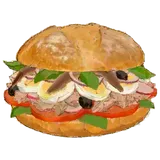
Pan bagnat (Pan banhat)
Also known as Bathed bread
2 places claim to have invented this one. The case file is below.
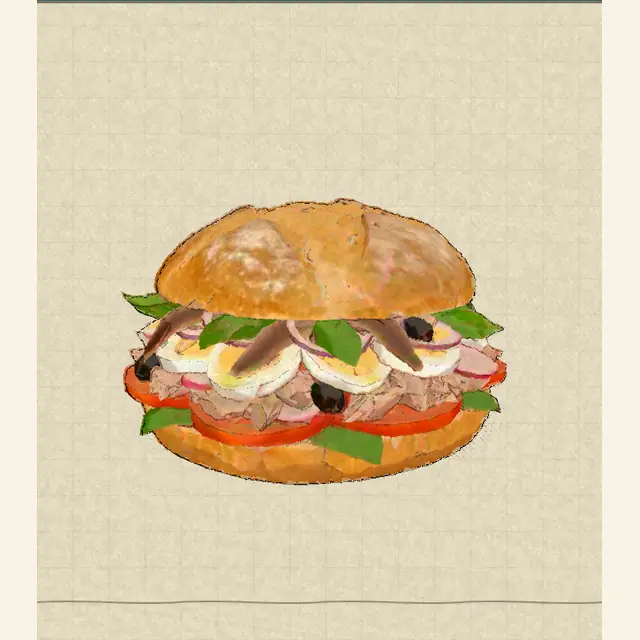
Medium confidenceAnatomy of the Pan bagnat
Origin story
Nice, France · 43.71°N, 7.26°E
A nineteenth-century snack of Niçois fishermen and market workers, built to use up stale bread and whatever salad vegetables were on hand rather than invented as a dish in its own right.
A nineteenth-century snack of Niçois fishermen and market workers, built to use up stale bread and whatever salad vegetables were on hand rather than invented as a dish in its own right. The name is Niçard: pan banhat, "bathed bread", describing the practical trick at its centre: day-old bread rounds, too dry to eat plainly, were soaked with olive oil and vinegar until soft, then packed with the same ingredients that make up salade niçoise. Larousse Gastronomique frames it exactly that way, as the salad transposed onto bread rather than a separate invention, which is the account most sources converge on. No source gives an exact date or names an inventor; this is a food that accreted out of thrift rather than one that was created at a moment anyone recorded.
No earliest documentary reference found, so the record is open. If you have one, that's worth more to us than another retelling.
The Dispute
We don't adjudicate. Here is the evidence for each claim, neutrally, with its source.
Nice, France
A nineteenth-century snack of Niçois fishermen and market workers, built to use up stale bread and whatever salad vegetables were on hand rather than invented as a dish in its own right. The name is Niçard: pan banhat, "bathed bread", describing the practical trick at its centre: day-old bread rounds, too dry to eat plainly, were soaked with olive oil and vinegar until soft, then packed with the same ingredients that make up salade niçoise. Larousse Gastronomique frames it exactly that way, as the salad transposed onto bread rather than a separate invention, which is the account most sources converge on. No source gives an exact date or names an inventor; this is a food that accreted out of thrift rather than one that was created at a moment anyone recorded.
Evidence: [2]
Unnamed claim
Authenticity is actively policed rather than just debated: after a Paris chef, Thierry Marx, served a version with honey-glazed chicken and mozzarella in 2018, Niçois locals formed an association, La Commune Libre du Pan Bagnat, to certify restaurants that follow the traditional recipe and to pursue UNESCO and AOC-style protected status for it.
Evidence: [2]
Our reconstruction
Notes on this reconstruction
Medium reflects the ingredient argument above as much as the thin dating: Nice now has an association actively certifying "correct" pan bagnat, which tells you how seriously the construction is taken locally. Their list runs to about eighteen components, including things we have simplified away (celery, capsicum, broad beans, purple artichoke) for a home kitchen. We keep the load-bearing choices: raw vegetables only, both tuna and anchovy rather than a forced choice between them, and a genuinely long oil-and-vinegar soak, which is the step most home versions skip and the one that actually makes the sandwich what it is rather than a salad with a lid.
- Yield
- 2 sandwiches
Method
Split the rolls and rub the cut faces with the garlic clove.
Douse both cut faces generously with olive oil and a little vinegar: this is the step the name describes, so do not be shy with it.
Layer in the tomato, tuna, anchovy, egg, olives, onion and artichoke or radish if using, seasoning lightly as you go, and tuck in the basil.
Close the rolls and wrap them tightly in greaseproof paper or foil.
Press under a light weight (a plate with a couple of tins on it works) and leave for at least an hour, ideally longer, so the oil and vinegar work all the way into the bread.
Unwrap and eat with your hands over a plate; a properly soaked pan bagnat will run down your wrists a little, which is correct.
Sources
- Pan bagnat: Wikipedia (retrieved 2026-09-24) Niçard etymology ("bathed bread"); day-old bread soaked in olive oil; Larousse Gastronomique framing as salade niçoise on bread
- Pan bagnat is the crowning jewel of Nice: SBS Food (retrieved 2026-09-24) 19th-century fishermen's snack; ~18-ingredient "official" recipe; 2018 Thierry Marx controversy and formation of La Commune Libre du Pan Bagnat