Bunny chow
Time Immemorial
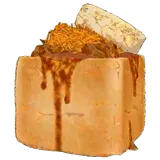
Bunny chow
Also known as Bunny
4 places claim to have invented this one. The case file is below.
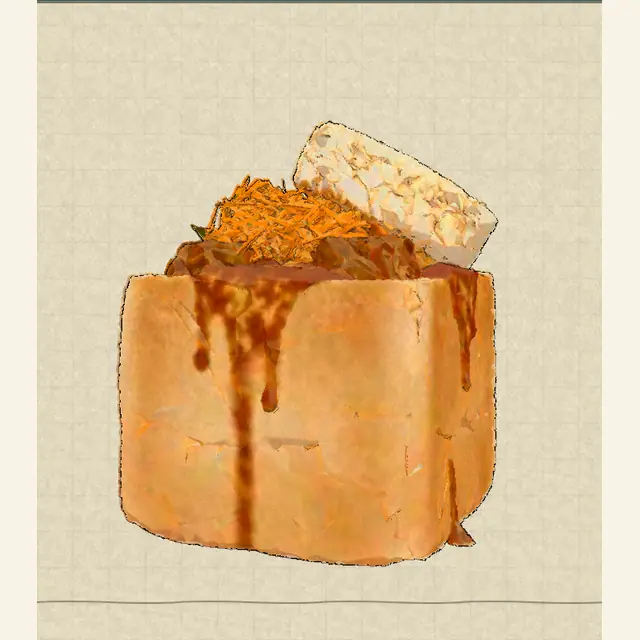
Medium confidenceAnatomy of the Bunny chow
Origin story
Durban, South Africa · 29.86°S, 31.02°E
Bunny chow, a hollowed-out quarter or half loaf of white bread filled with curry, is a Durban Indian invention, generally dated to somewhere in the first half of the 20th century, though no single account is agreed on.
Bunny chow, a hollowed-out quarter or half loaf of white bread filled with curry, is a Durban Indian invention, generally dated to somewhere in the first half of the 20th century, though no single account is agreed on. Several tellings share the same core: Indian traders and shopkeepers in Durban, many of them Banias (a merchant caste), sold curry in bread as a fast, edible meal for workers who couldn't easily sit down to eat, most often named to a café called Kapitan's at the corner of Victoria and Albert Streets. The name is usually explained as a corruption of 'Bania's chow' rather than any reference to rabbits. Wikipedia dates the dish's emergence to the 1940s; other reporting, including the Christian Science Monitor, places it more broadly in the early 20th century and adds that segregation-era exclusion from sit-down restaurants likely reinforced its takeaway format, without fixing a precise date.
No earliest documentary reference found, so the record is open. If you have one, that's worth more to us than another retelling.
The Dispute
We don't adjudicate. Here is the evidence for each claim, neutrally, with its source.
Bunny chow, a hollowed-out quarter or half loaf of white bread filled with curry, is a Durban Indian invention, generally dated to somewhere in the first half of the 20th century, though no single account is agreed on. Several tellings share the same core: Indian traders and shopkeepers in Durban, many of them Banias (a merchant caste), sold curry in bread as a fast, edible meal for workers who couldn't easily sit down to eat, most often named to a café called Kapitan's at the corner of Victoria and Albert Streets. The name is usually explained as a corruption of 'Bania's chow' rather than any reference to rabbits. Wikipedia dates the dish's emergence to the 1940s; other reporting, including the Christian Science Monitor, places it more broadly in the early 20th century and adds that segregation-era exclusion from sit-down restaurants likely reinforced its takeaway format, without fixing a precise date.
Durban, South Africa
Kapitan's café, run by Indian Bania traders at the corner of Victoria and Albert Streets, is the most frequently named point of origin, with the name explained as a corruption of 'Bania's chow.'
Evidence: [1]
Unnamed claim
A separate, harder-edged account ties the format to apartheid-era segregation directly: Black customers barred from many Durban restaurants and shops could still be sold a takeaway loaf of curry through a hatch, without setting foot inside.
Evidence: [2]
Gweru, Zimbabwe
Wikipedia also records bunny chow being sold in Gwelo, Rhodesia (now Gweru, Zimbabwe) during the Second World War, which complicates a purely Durban-only account, though Durban remains where the dish is overwhelmingly associated.
Evidence: [1]
Our reconstruction
Notes on this reconstruction
Durban recognises bean bunny and mutton bunny as the two anchor fillings, roughly split along vegetarian and non-vegetarian lines; we give mutton here as the more frequently cited default and treat bean as an equally traditional, not lesser, variant worth its own record. The scooped-out bread ('the virgin bread' in Durban slang) is served alongside for scooping, not discarded, which we've kept rather than treating as a garnish.
- Yield
- 4 bunny chows
Method
Fry the onion in ghee until deep gold, then add garlic-ginger paste and curry leaves and cook a minute more.
Stir in the masala and garam masala and fry briefly until fragrant, then add the tomato and cook down to a thick base.
Add the mutton, turning to coat, then enough water to cover. Simmer, covered, low and slow for at least 2 hours until the meat is falling off the bone.
Add the potato in the last 30 minutes and simmer until tender, the gravy thick enough to hold its shape on a spoon.
Cut the loaf into quarters and hollow out the centre of each, keeping the scooped bread whole to serve on the side.
Ladle the hot curry into each hollowed quarter until it's generously full.
Serve with the scooped bread and a sharp carrot and chilli sambal, eaten by tearing pieces of the loaf to scoop.
Sources
- Bunny chow: Wikipedia (retrieved 2026-09-24) 1940s dating; Kapitan's/Bania claim; golf-caddy story; Gwelo, Rhodesia wartime sales
- South Africa in a loaf of bread: The history of its beloved 'bunny chow', The Christian Science Monitor (retrieved 2026-09-24) Early-20th-century framing (broader than Wikipedia's 1940s); segregation-era takeaway context; Grey Street bunny shops