Lampredotto
Time Immemorial
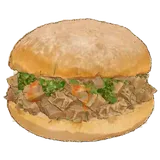
Lampredotto
2 places claim to have invented this one. The case file is below.
Medium confidenceAnatomy of the Lampredotto
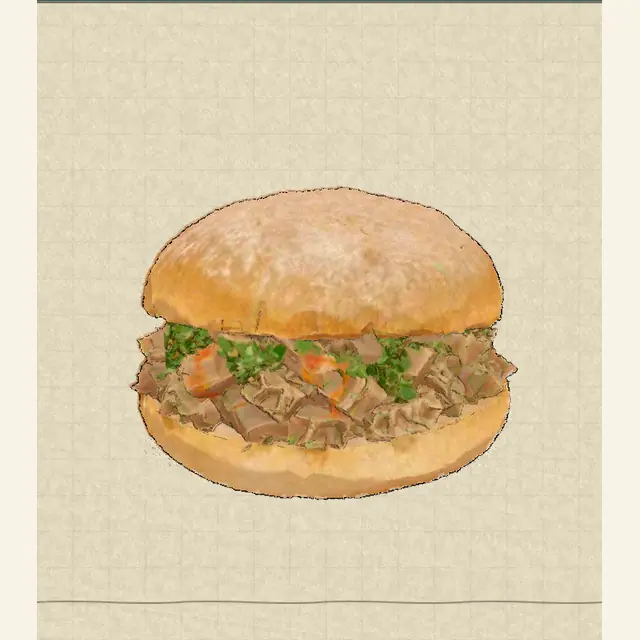
Origin story
Florence, Italy · 43.77°N, 11.26°E
A Florentine street food built from the abomasum, the fourth and last stomach chamber of a cow, sold from carts and later fixed stalls by vendors known as trippai.
A Florentine street food built from the abomasum, the fourth and last stomach chamber of a cow, sold from carts and later fixed stalls by vendors known as trippai. The name comes from lampreda (lamprey) because the tripe's stringy, textured surface was said to resemble the suckered mouth of the eel, itself a dish the city's wealthy prized and its poor could not afford; the joke, more or less, is that Florence's working class named their cheap offal after the rich man's fish it could never be. One trade-history source dates commercialisation of the dish to the fifteenth century, tied to the quinto quarto tradition of cooking the "fifth quarter" of the animal that better cuts left behind: we are treating that date cautiously, since it comes from a single tertiary source rather than anything we could verify independently, but the broader picture, of an offal trade running for centuries and eventually organising into something like a guild, is corroborated more generally.
No earliest documentary reference found, so the record is open. If you have one, that's worth more to us than another retelling.
The Dispute
We don't adjudicate. Here is the evidence for each claim, neutrally, with its source.
Florence, Italy
A Florentine street food built from the abomasum, the fourth and last stomach chamber of a cow, sold from carts and later fixed stalls by vendors known as trippai. The name comes from lampreda (lamprey) because the tripe's stringy, textured surface was said to resemble the suckered mouth of the eel, itself a dish the city's wealthy prized and its poor could not afford; the joke, more or less, is that Florence's working class named their cheap offal after the rich man's fish it could never be. One trade-history source dates commercialisation of the dish to the fifteenth century, tied to the quinto quarto tradition of cooking the "fifth quarter" of the animal that better cuts left behind: we are treating that date cautiously, since it comes from a single tertiary source rather than anything we could verify independently, but the broader picture, of an offal trade running for centuries and eventually organising into something like a guild, is corroborated more generally.
Evidence: [2]
Unnamed claim
A single trade-focused source dates the commercialisation of lampredotto to the fifteenth century, during the height of Medici-era Florence, as a food for the urban poor. We could not corroborate this specific century against a second independent source, so we are flagging it as under-evidenced rather than presenting it as settled.
Evidence: [2]
Our reconstruction
Notes on this reconstruction
Medium reflects the origin-dating problem above, not any uncertainty about how the dish is built today: the modern sandwich is completely standardised across Florence's trippai stalls. Two details are load-bearing: the tripe is simmered in a herb-and-vegetable broth until tender rather than grilled or fried, and the classic serving dips the top half of the roll in that same broth before assembling, which is where the texture actually comes from. Leave that step out and it is just a sandwich with tripe in it, not a lampredotto.
- Yield
- 2 sandwiches
Method
Simmer the tripe with the vegetables, tomato, bay and salt for two to three hours, until it is genuinely tender rather than merely cooked: it should give with almost no resistance.
Lift it out and keep the broth on a low simmer; slice the tripe into thin strips against the grain.
Make the salsa verde by finely chopping the parsley, garlic, capers and anchovy together and binding with olive oil.
Dip the cut side of the top half of each roll briefly into the hot broth, just enough to moisten it without turning it to mush.
Pile the warm sliced tripe onto the bottom half, spoon over the salsa verde and a few drops of the chilli oil, and close with the broth-dipped top.
Eat standing up, the way it is sold at the stalls, while the tripe is still hot.
Sources
- Lampredotto: Wikipedia (retrieved 2026-09-24) Etymology from lampreda/lamprey; abomasum cut; Florentine street food status
- Lampredotto: History, Info, Interesting Facts, WFC (retrieved 2026-09-24) 15th-century commercialisation claim; quinto quarto tradition; trippai street-cart vendors later forming a trade corporation