Bombay sandwich
Time Immemorial
Bombay sandwich
Also known as Bombay masala sandwich, Mumbai veg sandwich, Bombay veg toast sandwich
2 places claim to have invented this one. The case file is below.
ContestedAnatomy of the Bombay sandwich
Origin story
Mumbai (Bombay), India · 19.08°N, 72.88°E
Nobody has a name or a date for it.
Nobody has a name or a date for it. The most repeated account puts it in 1960s Bombay, as cheap, meatless food for the migrant workers who staffed the city's textile mills: the British brought the sandwich, the Portuguese had already brought bread and potatoes, and a street vendor put the two together with green chutney and whatever raw vegetables were cheap that day. The mill-worker story is reasoning backwards from the timing, not a recorded fact, and we mark it that way. What is firm is the place: it is a Mumbai street food first, sold across the city, and still uncommon elsewhere in India.
No earliest documentary reference found, so the record is open. If you have one, that's worth more to us than another retelling.
The Dispute
We don't adjudicate. Here is the evidence for each claim, neutrally, with its source.
Mumbai (Bombay), India
Nobody has a name or a date for it. The most repeated account puts it in 1960s Bombay, as cheap, meatless food for the migrant workers who staffed the city's textile mills: the British brought the sandwich, the Portuguese had already brought bread and potatoes, and a street vendor put the two together with green chutney and whatever raw vegetables were cheap that day. The mill-worker story is reasoning backwards from the timing, not a recorded fact, and we mark it that way. What is firm is the place: it is a Mumbai street food first, sold across the city, and still uncommon elsewhere in India.
Evidence: [1]
Mumbai, India
The mill-worker origin and the 1960s date are food-writer opinion rather than documented history; the exact invention date is unknown and the sandwich may be older or younger than the story says.
Evidence: [1]
Our reconstruction
Notes on this reconstruction
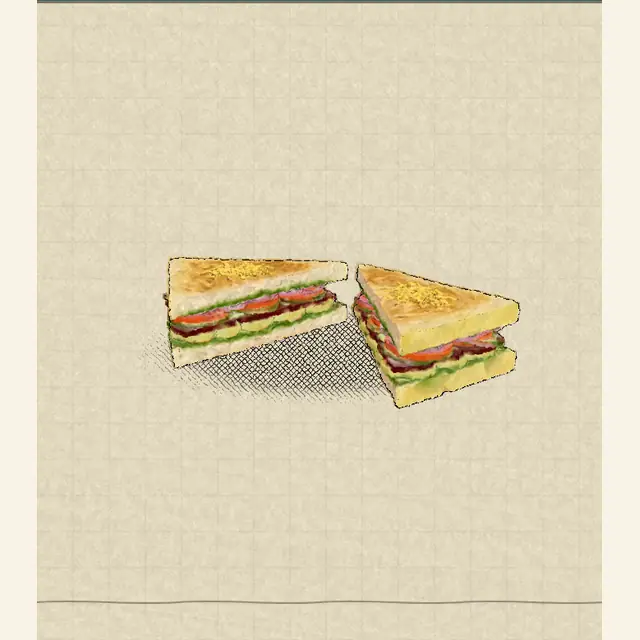
Confidence is contested because the origin is a plausible story, not a record. The filling is standard across our sources: boiled potato plus raw onion, cucumber, tomato and beetroot, with green chutney and a dusting of chaat masala. The cheese and sev toppings are the common modern finishes and we show sev here because it is the one most often seen on a street-stall plate. Early versions were reportedly untoasted and served with a cheap ketchup; toasting came later, and cheese later still.
- Yield
- 2 sandwiches
Method
Butter all four slices on one side and spread two of them with green chutney.
Lay potato, beetroot, cucumber, tomato and onion in even layers over the chutney, sprinkling chaat masala between layers and a little salt on the potato.
Close with the other two slices, buttered side down, and press flat.
Toast on a hot griddle or sandwich press until both faces are crisp and golden and the middle is warm.
Cut each sandwich into four, stand the pieces up to show the layers, and scatter sev across the top. Serve at once with ketchup or extra chutney.
Sources
- Bombay sandwich: Wikipedia (retrieved 2026-11-02) Mumbai street food; exact invention date unknown; 1960s mill-worker theory (Vijayakar, Ved); standard ingredients; Portuguese bread and potato, British sandwich
- How The Bombay Sandwich Outlived The Industry That (Likely) Spawned It: Mashed (retrieved 2026-11-02) 1960s migrant textile worker theory, hedged; mills closed after 1980s strikes; potato, onion, beetroot, green chutney, white bread