Kati roll
Jazz Age
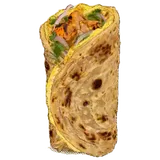
Kati roll (কাঠি রোল)
Also known as Kathi roll
3 places claim to have invented this one. The case file is below.
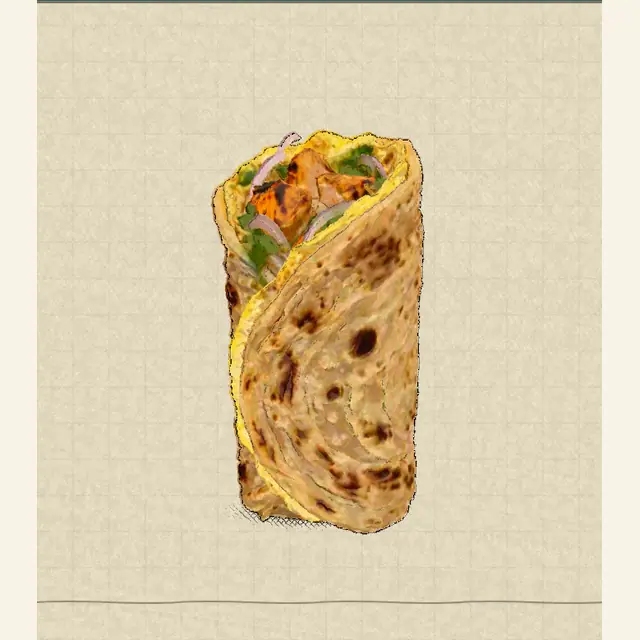
Medium confidenceAnatomy of the Kati roll
Origin story
New Market, Kolkata, India · 22.56°N, 88.35°E
The kati roll was developed at Nizam's, a Mughlai kebab restaurant Raza Hassan Saheb opened in Kolkata's New Market area in 1932.
The kati roll was developed at Nizam's, a Mughlai kebab restaurant Raza Hassan Saheb opened in Kolkata's New Market area in 1932. The best-known version of the story has Nizam's wrapping skewer-roasted kebabs in paratha so a rushed or squeamish customer (accounts differ on whether it was a hurried commuter or a British patron unwilling to eat kebab by hand) could eat them cleanly and on the move, without touching the meat directly. Nizam's held close to a monopoly on the format for years before it spread across Kolkata and then further afield. The 'kati' name came later: the restaurant's heavy iron skewers were eventually replaced with bamboo ones, called kathi ('stick') in Bengali, and the roll took the name of the skewer rather than the other way round.
1932
Raza Hassan Saheb opens Nizam's in New Market, Kolkata, serving skewer-kebabs that would later be wrapped in paratha and eventually named the kati roll [1]
The Dispute
We don't adjudicate. Here is the evidence for each claim, neutrally, with its source.
The kati roll was developed at Nizam's, a Mughlai kebab restaurant Raza Hassan Saheb opened in Kolkata's New Market area in 1932. The best-known version of the story has Nizam's wrapping skewer-roasted kebabs in paratha so a rushed or squeamish customer (accounts differ on whether it was a hurried commuter or a British patron unwilling to eat kebab by hand) could eat them cleanly and on the move, without touching the meat directly. Nizam's held close to a monopoly on the format for years before it spread across Kolkata and then further afield. The 'kati' name came later: the restaurant's heavy iron skewers were eventually replaced with bamboo ones, called kathi ('stick') in Bengali, and the roll took the name of the skewer rather than the other way round.
Unnamed claim
Sources agree on Nizam's and roughly the 1930s–40s but not on the precise trigger for the roll format: Wikipedia gives the 'British patrons too fastidious to eat by hand' story, while The Better India instead describes a single rushed customer being handed a kebab-filled paratha on the spot. Neither is sourced to a contemporary account, only restaurant tradition.
Evidence: [2]
Unnamed claim
Wikipedia dates the switch from iron to bamboo skewers, and the resulting 'kati' name, to 1964; The Better India describes the same switch without giving a year, as part of the restaurant's earlier general innovation rather than a dated event.
Evidence: [1]
Our reconstruction
Notes on this reconstruction
The paratha needs to be laminated in layers to survive a hot, wet filling without collapsing: a plain flatbread won't hold up. We use the 'egg roll' technique common at most modern kati stalls, where a beaten egg is seared onto one face of the paratha as it cooks, which seals the dough and adds richness; it's a later, near-universal addition rather than part of Nizam's 1930s original, and we've kept it because it's now closer to how the dish is actually eaten than the plain version is.
- Yield
- 4 rolls
Method
Marinate the chicken in yoghurt, ginger-garlic paste, spices and lemon juice for at least 2 hours.
Skewer or pan-skewer the chicken and cook over high heat until charred at the edges and cooked through.
Make a laminated dough with flour, water, salt and ghee folded through in layers, then rest it for 30 minutes.
Roll each portion of dough thin and cook on a hot griddle with ghee until mostly set, then pour a thin layer of beaten egg over the top face and flip so the egg sears onto the bread.
Lay the cooked paratha egg-side up, spread with green chutney, and pile on the hot chicken, sliced onion and a scatter of chaat masala.
Roll tightly, wrap the base in paper to hold it closed, and eat immediately.
Sources
- Kati roll: Wikipedia (retrieved 2026-09-24) Nizam's, 1932, Raza Hassan Saheb; 1964 switch to bamboo ('kathi') skewers; British-patrons story
- How One Man's Ingenious Hack Took 'Kathi Rolls' From Kolkata to the World: The Better India (retrieved 2026-09-24) Alternative telling: rushed customer, paratha wrap on the spot; bamboo-skewer switch described without a year