Trancapecho
Time Immemorial
Trancapecho
Also known as tranca pecho, trancapecho cochabambino, silpancho en pan, silpancho sandwich
Cochabamba, Bolivia takes this one uncontested, with no rival claims on file.
Medium confidenceAnatomy of the Trancapecho
Origin story
Cochabamba, Bolivia · 17.39°S, 66.16°W
The trancapecho is a Cochabamba street sandwich built from silpancho, the city's plate of rice, potato, thin breaded beef, fried egg and a raw tomato and onion salad.
The trancapecho is a Cochabamba street sandwich built from silpancho, the city's plate of rice, potato, thin breaded beef, fried egg and a raw tomato and onion salad. Every source we read calls it a silpancho put in bread and places it in Cochabamba, in markets, street stalls and restaurants. We found no dated first reference, no inventor and no first stall; the account is oral and undated. The silpancho underneath has a named creator, Celia La Fuente Peredo (1928 to 2008), whose restaurant on Calle Lanza, Cochabamba, is credited with giving the plate its present form, but no source we fetched says she or anyone else made the first sandwich. The name means roughly 'chest lock', for how dry and filling it is.
No earliest documentary reference found, so the record is open. If you have one, that's worth more to us than another retelling.
Our reconstruction
Notes on this reconstruction
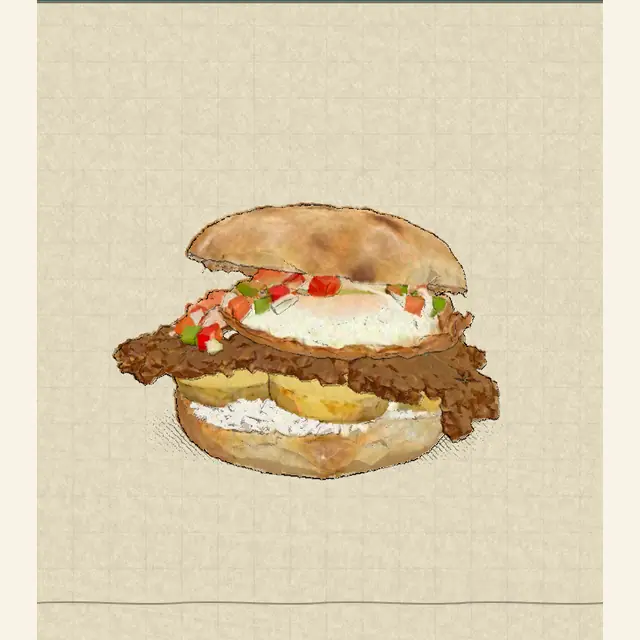
We build it as a round bun split but left hinged, holding rice, fried potato, one thin breaded beef cutlet, a fried egg and a raw salad of tomato, onion and locoto. All the sources we fetched agree the rice is inside; the Spanish-language recipe and the English Wikipedia entry list rice, potato, meat, egg and salad together. They disagree on the bread. Wikipedia says 'bread tortilla'; a Commons caption says pan toco or tortilla, a round flat bun from clay ovens; a recipe says only 'bread', cut but left joined on one side. Los Tiempos reports that Cochabamba counts toco and marraqueta as the cheap pan de batalla and tortilla bread as a richer bread with lard or cheese, so the bread name is loose. The photographs we looked at all show a round, slightly flattened bun with a thin golden crust, not a marraqueta, so we use a round bun. Layer order is not fixed: the one recipe that gives a stacking puts cutlet, potato, rice, egg and salad in that order from the bread, while the photographs vary (rice at the bottom in one, cutlet draped across the top in another). The cutlet is wider than the bun and sticks out, which a recipe source states is typical. The cutlet is pounded on ground stale bread so it spreads without tearing. We give quantities ourselves; no source does. Llajwa or other hot sauce is common elsewhere but not in the sources we fetched, so we leave it out. Confidence is medium: the build is consistent across sources, the origin and bread name are not.
- Yield
- 4 sandwiches
Method
Cook the rice plain and keep it warm. Dice the tomato, onion and locoto together with a pinch of salt for the salad.
Pound each steak between sheets of film with a mallet, working crumbs into it, until it is very thin and wider than the bun.
Dip in beaten egg, coat again in crumbs and shallow-fry until crisp and deep brown on both sides. Drain.
Fry the potato slices in the same oil until golden and soft. Fry the eggs, leaving the yolks a little runny.
Split the buns but leave one side joined. Stack in this order: rice, potato, cutlet, fried egg, then a spoonful of salad on top.
Close the bun on it. The cutlet will stick out round the edges. Eat at once, wrapped in paper.
Sources
- Trancapecho: Wikipedia (retrieved 2026-10-30) Sandwich from Cochabamba derived from silpancho; breaded meat, fried potatoes, fried egg, rice, salad of tomato, onion and locoto; 'bread tortilla'; no date or inventor
- Silpancho: Wikipedia (retrieved 2026-10-30) Silpancho is a Cochabamba dish, Quechua sillp'anchu; rice, boiled potato, breaded pounded meat, tomato, onion salad, fried egg; found in a sandwich called trancapecho containing everything including rice
- El Silpancho, ABC Color (Paraguay) (retrieved 2026-10-30) Silpancho created by Celia La Fuente Peredo (1928 to 2008) on Calle Lanza, Cochabamba; trancapecho recipe with rice, potato, egg, tomato-onion-locoto salad; meat larger than the bread; pounded on ground stale bread; name from the dryness
- Trancapecho recipe, Los Tiempos (Cochabamba) (retrieved 2026-10-30) Published 14 Sep 2016; 'una especie de Silpancho en pan', eaten at night; bread cut but joined on one side; cutlet, fried potato, rice, fried egg, onion and tomato, optional locoto
- File: El trancapecho un plato cochabambino... pan toco o tortilla 02.jpg, Wikimedia Commons (retrieved 2026-10-30) Caption: sandwich of meat, egg, rice and more on pan toco or tortilla, a round flat bread from clay ovens; quick portable silpancho; stalls, markets, restaurants
- La Intendencia controla el precio y peso justo del pan de batalla, Los Tiempos (retrieved 2026-10-30) Toco and marraqueta count as pan de batalla; tortilla bread does not because it contains lard or cheese; 60 g minimum per unit; says nothing on shape
