Po' boy
Jazz Age
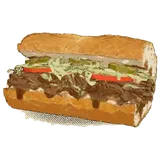
Po' boy
Also known as Poor boy, Po-boy
2 places claim to have invented this one. The case file is below.
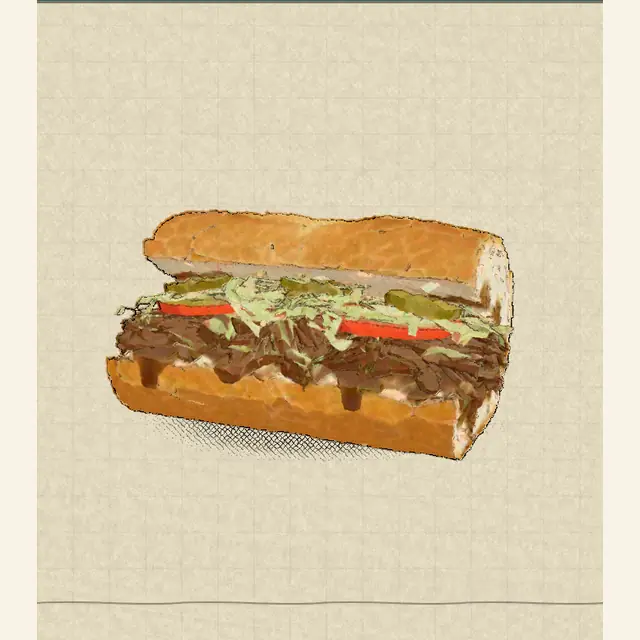
Medium confidenceAnatomy of the Po' boy
Origin story
French Market, New Orleans, Louisiana, USA · 29.96°N, 90.06°W
Bennie and Clovis Martin, both former streetcar conductors themselves, ran a coffee stand and restaurant in the French Market.
Bennie and Clovis Martin, both former streetcar conductors themselves, ran a coffee stand and restaurant in the French Market. When New Orleans streetcar workers went on strike on 1 July 1929, the Martins fed their old colleagues for free for the four months the strike lasted. Bennie later said staff would announce 'here comes another poor boy' when a striker walked in, and the name moved from the men to the sandwich. It began appearing in newspapers and on menus in the early 1930s. We give this account as the claim because it is the one the Martins themselves told from the 1960s on, though see the dispute below. The story is older than its first appearance in print by roughly forty years, which is the kind of gap that should make anyone cautious.
1929
Martin Brothers' Coffee Stand and Restaurant feeds striking streetcar workers for free through the four-month 1929 New Orleans streetcar strike: the event later credited with the sandwich's name [1]
The Dispute
We don't adjudicate. Here is the evidence for each claim, neutrally, with its source.
French Market, New Orleans, Louisiana, USA
Bennie and Clovis Martin, both former streetcar conductors themselves, ran a coffee stand and restaurant in the French Market. When New Orleans streetcar workers went on strike on 1 July 1929, the Martins fed their old colleagues for free for the four months the strike lasted. Bennie later said staff would announce 'here comes another poor boy' when a striker walked in, and the name moved from the men to the sandwich. It began appearing in newspapers and on menus in the early 1930s. We give this account as the claim because it is the one the Martins themselves told from the 1960s on, though see the dispute below. The story is older than its first appearance in print by roughly forty years, which is the kind of gap that should make anyone cautious.
Evidence: [1]
Unnamed claim
At least one New Orleans historian has questioned the strike story, pointing out that it wasn't reported in the local press until roughly forty years after the fact, and that before 1969 the Martins' own telling credited the name to feeding farmers, dockworkers and other poor boys who frequented their French Market location generally, not specifically to strikers in 1929.
Evidence: [3]
Our reconstruction
Notes on this reconstruction
Po-boys split into two big families: roast beef 'debris' (scraps and gravy from the roasting pan) and fried seafood, usually shrimp or oyster. We build the roast beef version because it ties directly to the origin story of cheap, filling food for working men, and because the gravy-soaked bread is the harder thing to get right at home, which makes it the more useful record. A proper New Orleans French loaf (thin, shattering crust, airy crumb) is not really substitutable; a baguette is close but denser.
- Yield
- 1 po-boy, ~30 cm
Method
Roast the chuck low and slow, covered, with stock and garlic until it shreds apart at the touch of a fork: this is the whole foundation of the sandwich, so don't rush it.
Pull the beef apart into rough shreds directly in its own liquid rather than slicing it; 'debris' means torn, not carved.
Strain the cooking liquid, whisk it into a light roux in a separate pan until it thickens into a loose gravy, then return the shredded beef to it and keep it warm.
Split the French loaf lengthways, keeping a hinge, and warm it briefly so the crust re-crisps.
Spread mayonnaise generously on both cut faces: it is a moisture barrier as much as a flavour, holding the bread together against the gravy.
Load the beef and a generous ladle of gravy onto the bottom half, letting it soak slightly into the crumb.
Dress with lettuce, tomato, pickles and hot sauce, then close and press gently. Eat over a plate; it is meant to fall apart a little.
Sources
- Po' boy: Wikipedia (retrieved 2026-09-24) 1929 streetcar strike; Martin Brothers; naming account
- Po-Boy Sandwich: 64 Parishes (retrieved 2026-09-24) French Market context; roast beef and fried seafood variants
- The messy history of the po-boy: The Lost Cajun (retrieved 2026-09-24) Historian's skepticism of the 1929 strike story; pre-1969 Martin family account