Bokit
Time Immemorial
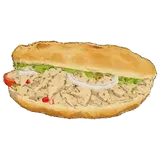
Bokit
Also known as bokits, pain bokit, djonkit, bokit guadeloupéen
3 places claim to have invented this one. The case file is below.
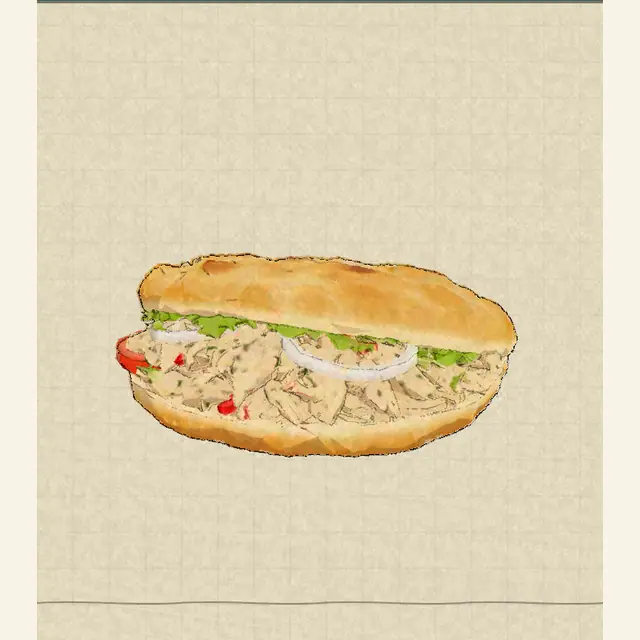
Medium confidenceAnatomy of the Bokit
Origin story
Pointe-à-Pitre, Guadeloupe, Guadeloupe (France) · 16.24°N, 61.53°W
The fried bread is older than the sandwich.
The fried bread is older than the sandwich. Accounts trace it to the period after slavery was abolished in 1848, when poor labourers made their own bread and fried it in a pot of oil, a cousin of the johnny cake (New England 'journey cake') that reached the French islands as 'djonkit'. The sandwich form, the fried bread split and filled, is credited by Air Caraïbes to a Pointe-à-Pitre street vendor, Mathurine Parnas, around the 1960s. Both accounts are oral or loosely dated: we found no dated written reference to either the bread's first frying or Parnas's first stall, and the mid-nineteenth-century story is repeated by tourism and food pages rather than historians.
No earliest documentary reference found, so the record is open. If you have one, that's worth more to us than another retelling.
The Dispute
We don't adjudicate. Here is the evidence for each claim, neutrally, with its source.
The fried bread is older than the sandwich. Accounts trace it to the period after slavery was abolished in 1848, when poor labourers made their own bread and fried it in a pot of oil, a cousin of the johnny cake (New England 'journey cake') that reached the French islands as 'djonkit'. The sandwich form, the fried bread split and filled, is credited by Air Caraïbes to a Pointe-à-Pitre street vendor, Mathurine Parnas, around the 1960s. Both accounts are oral or loosely dated: we found no dated written reference to either the bread's first frying or Parnas's first stall, and the mid-nineteenth-century story is repeated by tourism and food pages rather than historians.
New England, United States
Several French food pages push the ancestry further back: a corn galette made by the Shawnee in New England, adopted by colonists and carried to the Antilles via Louisiana, with enslaved people then frying their own bread. Wikipedia likewise ties the bokit to the johnny cake and a possible Indigenous corn origin. This is an etymological and plausibility argument, not a documented route.
Evidence: [4]
Guadeloupe
Against the 1960s sandwich date, Routard says the filled bread was developing from the mid-nineteenth century, with workers filling it with the previous day's leftovers. The two dates are about a century apart and do not necessarily conflict, since one is the bread and the other the street sandwich.
Evidence: [4]
Our reconstruction
Notes on this reconstruction
We give the yeasted version: a flat disc of wheat dough fried in deep oil until it puffs, cut about three-quarters of the way through along one edge so the top lifts like a lid, and filled. The sources agree on a plain dough of flour, water, salt and yeast, fat optional (Air Caraïbes and Du Boc à l'Assiette add margarine or lard; Wikipedia says the original had no yeast and used bicarbonate). Sizes drift: one recipe makes 8 cm discs before frying, others make four to six larger rounds. Photographs show them roughly hand-sized to saucer-sized and about 2 cm thick when puffed. They are also not strictly uniform: some recipes say 'cut lengthwise', one says cut through the thickness. We went with the three-quarter cut because it is the most specific description and matches the hinged look in photographs. There is no single standard filling. Chicken (often with a lime-herb sauce), salt cod (chiquetaille de morue, with sauce chien) and ham and cheese are all given as the usual choices, with raw tomato, onion and lettuce. We chose salt cod because it is the classic and named in most sources; the ham-and-cheese version is probably the commonest sold today. Breadfruit flour appears in some intros but not in any quantified recipe. Confidence is medium: the bread and the build are consistent, the filling and origin are not. The model shows a flaked pale filling that could be cod chiquetaille or shredded chicken, the two commonest choices.
- Yield
- 6 bokits
Method
Mix the flour, yeast, salt and fat, add the water gradually and knead for about five minutes into a soft dough. Cover and leave for two to three hours until doubled.
Knock the dough back, divide it into six and flatten each piece by hand into a disc about 12 cm across and 1 cm thick.
Heat the oil to about 170 C and fry the discs one or two at a time, turning and spooning oil over them, for around four minutes a side, until they puff and turn an even golden brown. Drain on paper.
Let them cool slightly, then slice each one about three-quarters of the way through along one edge so it opens like a book, with the far side still joined.
Fill with the flaked cod mixed with onion, lime, parsley and chilli, then sliced tomato and a little lettuce or raw onion. Eat at once, while the bread is still crisp outside and soft inside.
Sources
- Bokit: Wikipedia (retrieved 2026-10-30) Mid-19th century after abolition; fried 'kettle bread'; johnny cake and journey cake; djoncake, djonkit, dannkit; flour, water, salt, bicarbonate or yeast; photos of chicken and salt cod bokit; no shape or size given in text
- Recette des bokits: Air Caraïbes (retrieved 2026-10-30) Pointe-à-Pitre street sandwich around the 1960s credited to Mathurine Parnas; dough for 6 bokits with margarine; fried about 4 minutes a side; split through the thickness; chicken with lime-herb sauce, mayonnaise or Creole sauce
- Comment faire la pâte à bokit: Du Boc à l'Assiette (retrieved 2026-10-30) Four equal balls flattened to discs; fried about 4 minutes; cut about three-quarters through; puffs to form a pocket; chicken, cod with sauce chien, ham and cheese, tuna, salad; Guadeloupe and Martinique
- Recette de bokits au poulet fumé: Routard (retrieved 2026-10-30) Round discs about 8 cm, fried at 170 C; bread fried in a pot before filling with chicken, cod or raw vegetables; Shawnee 'jonikin' ancestry; mid-19th century leftovers account; smoked chicken, lime, avocado
- Les 15 spécialités culinaires de la Guadeloupe: Génération Voyage (retrieved 2026-10-30) Enslaved people frying their own bread; crisp outside and soft inside; usual filling ham and cheese, also salt cod, chicken, tuna; raw vegetables and sauce; sold from food trucks
- La recette du vrai bokit guadeloupéen: Demotivateur (retrieved 2026-10-30) 400 g flour, yeast, oil, 300 ml water; 3-hour rise; six small discs; fried, turned throughout; cut lengthwise; salad, cheese, chicken or cod. Used for quantities only