Sabich
Atomic Drive-In
Sabich (סביח)
2 places claim to have invented this one. The case file is below.
Medium confidenceAnatomy of the Sabich
Origin story
Ramat Gan, Israel, Israel (built on an older Iraqi Jewish tradition) · 32.07°N, 34.82°E
Sabich Tzvi Halabi, an Iraqi Jewish immigrant born in Baghdad in 1938, opened a kiosk on Uziel Street in Ramat Gan with his wife Rina in 1961.
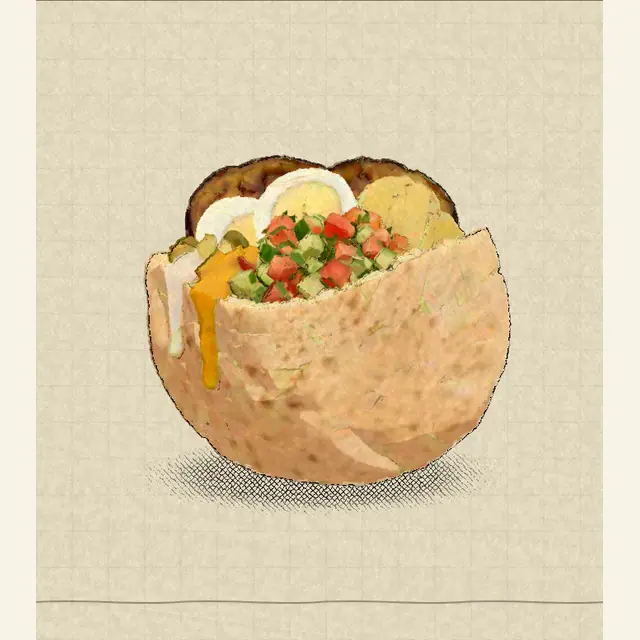
Sabich Tzvi Halabi, an Iraqi Jewish immigrant born in Baghdad in 1938, opened a kiosk on Uziel Street in Ramat Gan with his wife Rina in 1961. Bus drivers on the route wanted something more filling than a snack, and Halabi answered by combining the elements of a traditional Iraqi Jewish Sabbath breakfast (fried eggplant, hard-boiled egg, potato, salads, amba) inside a single pita, dishes that had previously been eaten separately at the family table. The Sabbath meal itself is much older and belongs to the wider Iraqi Jewish community; Halabi's specific, datable contribution was putting it in a pita and selling it as street food.
1961
Sabich Tzvi Halabi and his wife Rina open a kiosk on Uziel Street, Ramat Gan, serving the Iraqi Jewish Sabbath breakfast combination inside a pita [1]
The Dispute
We don't adjudicate. Here is the evidence for each claim, neutrally, with its source.
Ramat Gan, Israel
Sabich Tzvi Halabi, an Iraqi Jewish immigrant born in Baghdad in 1938, opened a kiosk on Uziel Street in Ramat Gan with his wife Rina in 1961. Bus drivers on the route wanted something more filling than a snack, and Halabi answered by combining the elements of a traditional Iraqi Jewish Sabbath breakfast (fried eggplant, hard-boiled egg, potato, salads, amba) inside a single pita, dishes that had previously been eaten separately at the family table. The Sabbath meal itself is much older and belongs to the wider Iraqi Jewish community; Halabi's specific, datable contribution was putting it in a pita and selling it as street food.
Evidence: [1]
Unnamed claim
The name's origin has at least three competing folk explanations: a mishearing of customers asking Halabi to 'make me a dish' as the dish's own name; the Arabic sabah ('morning'), referencing the breakfast; and a backronym for 'salat, beitza, yoter ḥatsil' (salad, egg, more eggplant). None is confirmed as the true source.
Evidence: [1]
Our reconstruction
Notes on this reconstruction
No written 1961 recipe from Halabi's own stand survives, so this is a reconstruction from the standard, well-documented modern combination rather than a verified original. Amba, a pickled, fenugreek-sour mango sauce brought by Iraqi Jews via India, is the one ingredient every source treats as non-negotiable, so we don't offer a substitute for it.
- Yield
- 4 pita
Method
Salt the aubergine slices and leave them 20 minutes to draw out moisture, then pat dry.
Shallow-fry or roast the slices until deeply golden and soft through: they should collapse slightly under a fork.
Boil the eggs to a firm set, cool, peel and slice.
Boil the potato until tender, then slice.
Warm the pita and split it into a pocket.
Spread hummus or tahini along the inside, then layer in aubergine, egg and potato.
Add Israeli salad and pickles, then finish generously with amba: it should be tasted in every bite, not drizzled as an afterthought.
Sources
- Sabich: Wikipedia (retrieved 2026-09-24) Sabich Tzvi Halabi, born Baghdad 1938; kiosk on Uziel Street, Ramat Gan, 1961; three competing name-origin theories
- How Iraqi Jews Shaped Israeli Cuisine: The Story of Sabich, med.kitchen (retrieved 2026-09-24) Confirms Sabich Tzvi Halabi, Ramat Gan, and the Iraqi Sabbath-breakfast basis; evolution from home dish to street food