Leberkässemmel
Time Immemorial
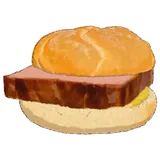
Leberkässemmel
Also known as Leberkäsesemmel, Leberkassemmel, Leberkässemmerl, Leberkäs-Semmel, Fleischkäsesemmel, LKW
3 places claim to have invented this one. The case file is below.
Medium confidenceAnatomy of the Leberkässemmel
Origin story
Vienna, Austria · 48.21°N, 16.37°E
We found no dated first Leberkässemmel and no inventor.
We found no dated first Leberkässemmel and no inventor. What the sources do show is that Austria treats it as its own: the Austrian register of traditional foods calls the roll with a slice of Leberkäse the most popular way to eat it, Vienna's tourist board calls it the country's fast food par excellence, and it is a fixture at Würstelstände. We place the pin in Vienna because that is where the sources locate the stand culture, not because anyone documents a first sandwich there. The roll is a Kaisersemmel, which the German Wikipedia traces to Austria and to Maria Theresa's court in the eighteenth century. The Leberkäse itself is the contested part, and the sandwich cannot be older than the loaf.
No earliest documentary reference found, so the record is open. If you have one, that's worth more to us than another retelling.
The Dispute
We don't adjudicate. Here is the evidence for each claim, neutrally, with its source.
We found no dated first Leberkässemmel and no inventor. What the sources do show is that Austria treats it as its own: the Austrian register of traditional foods calls the roll with a slice of Leberkäse the most popular way to eat it, Vienna's tourist board calls it the country's fast food par excellence, and it is a fixture at Würstelstände. We place the pin in Vienna because that is where the sources locate the stand culture, not because anyone documents a first sandwich there. The roll is a Kaisersemmel, which the German Wikipedia traces to Austria and to Maria Theresa's court in the eighteenth century. The Leberkäse itself is the contested part, and the sandwich cannot be older than the loaf.
Munich, Bavaria, Germany
The Austrian register records a legend that Leberkäse took its modern form in the Electorate of Bavaria in the late eighteenth century, when Karl Theodor moved his court from Mannheim to Munich in 1778 and a butcher he brought with him baked finely minced pork and beef in loaf form. The same text says the story is legend, notes linguists disagree on the name, and says the modern product depends on the bowl cutter and refrigeration. German Wikipedia calls the baked loaf typical of Bavaria. The register itself lists the dish as Bavarian-Austrian.
Evidence: [1]
Mannheim, Germany
A Rhine-Neckar local blog states flatly that Leberkäse (Lewwakäs) is a Mannheim invention, by the butcher Karl Theodor brought to Munich. It gives no sources and no exact year, so it reads as local pride rather than evidence, but it shows the Palatinate claim is still made.
Evidence: [6]
Our reconstruction
Notes on this reconstruction
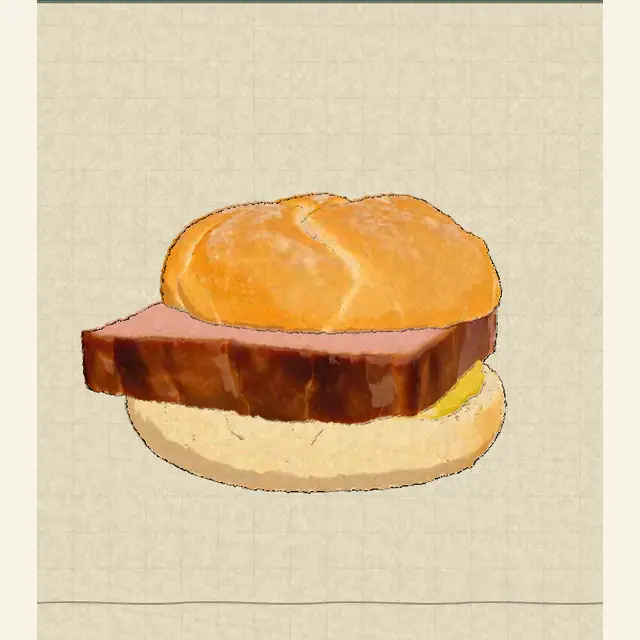
We give the Austrian counter version: a Kaisersemmel split, a warm finger-thick slice of baked Leberkäse, and mustard. The Austrian register defines the loaf as an emulsified sausage of about 48 parts beef or pork, 20 parts bacon and 32 parts water, baked at 150 to 180 C, with up to 6 parts potato starch optional. Those proportions are the only recipe numbers we have from a source; the spices (marjoram, nutmeg, white pepper, a little onion and garlic) are our reconstruction from general practice, since the pages we fetched do not list them. Liver is not required: German Wikipedia says Austrian versions once contained some and that is no longer typical. Mustard: German Wikipedia names sweet or medium-hot (mittelscharf); Vienna's tourist board names mustard and horseradish (Kren), with Gurkerl or ketchup. None of the sources fixes one mustard, so we say sweet or medium-hot and leave it to taste. Gurkerl are optional: every order in the Salzburg24 test came with them, but as a side or added item rather than a layer, and Vienna's board lists them as one choice among several. The roll varies: Vienna sources say Semmel, photographs show Kaisersemmel with a five-part stamp or a spiral, and German Brötchen (an oval roll) appear in German photos. Confidence is medium: the build is consistent, the origin and the Bavarian question are not settled.
- Yield
- 4 sandwiches
Method
Grind or chop the meat and fat, then blend in a powerful processor with the salt, spices and ice until you have a smooth, pale pink paste. Work in short bursts so it stays cold.
Pack into a loaf tin, smooth the top, and bake at about 170 C until the top is deeply browned and a thermometer in the middle reads 72 C, around 60 to 75 minutes.
Rest for ten minutes. Slice about a finger thick, 1.5 to 2 cm. The brown crust end, the Scherzl, is the one many customers ask for.
Split a Semmel across the middle and spread the cut faces with mustard.
Lay one warm slice inside; it may overhang the roll. Add horseradish if you like and eat at once, with gherkins on the side.
Sources
- Leberkäse, Register der Traditionellen Lebensmittel, BMLUK (Austria) (retrieved 2026-10-30) Register no. 156; legend of Karl Theodor's Mannheim butcher, 1778; Bavarian-Austrian cuisine; Leberkäsesemmel the most popular way to eat it in Austria; Codex recipe 48 meat / 20 bacon / 32 water, baked 150 to 180 C; Scherzl
- Leberkäse: Wikipedia (German) (retrieved 2026-10-30) Finger-thick warm slice in a split roll; Leberkassemmel in Bavaria and Austria; sweet or medium-hot mustard; baked loaf typical of Bavaria; Austrian versions once had liver
- Kurioses, Wien.info (Vienna Tourist Board) (retrieved 2026-10-30) Leberkäs'-Semmel described as one of Vienna's favourite snacks and Austrian fast food par excellence; mustard and Kren, Gurkerl or ketchup; sold at Würstelstände
- Snack-Klassiker im Check: Leberkässemmerl im Test, Salzburg24 (retrieved 2026-10-30) Semmel the standard (Salzweckerl as a fallback); Gurkerl with every order; hot, generous piece of Leberkäse with a hearty crust; no mention of mustard
- Kaisersemmel: Wikipedia (German) (retrieved 2026-10-30) Star-shaped cut on top from five folded parts; thick crisp crust, soft crumb; minimum 46 g; from Austria, documented at Maria Theresa's court in the 18th century
- Die Wittelsbacher un de Lewwakäs, Rhein-Neckar-Blog (retrieved 2026-10-30) States the Leberkäse is a Mannheim invention by Karl Theodor's butcher after the move to Munich; no sources, no exact year