Fischbrötchen
Time Immemorial
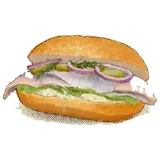
Fischbrötchen
Also known as Fish roll
2 places claim to have invented this one. The case file is below.
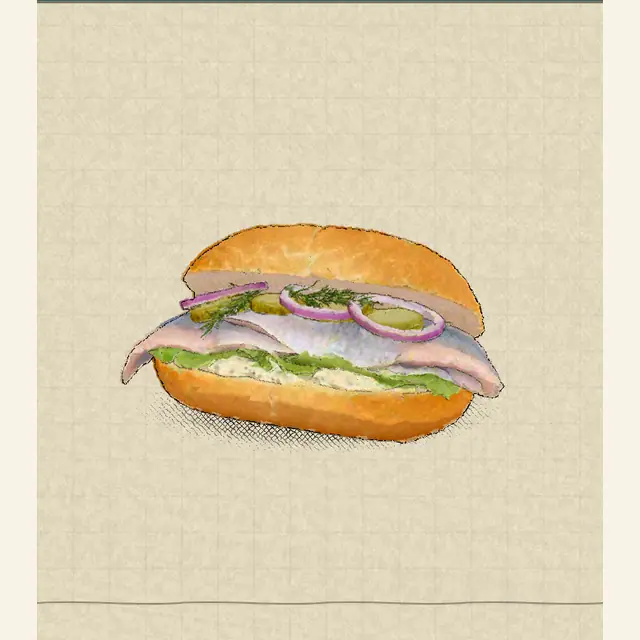
Medium confidenceAnatomy of the Fischbrötchen
Origin story
Hamburg, Germany · 53.55°N, 9.97°E
A harbour-workers' food from Germany's North Sea and Baltic coast, built around whatever fish came off the boats that morning, herring most often, packed into a bread roll for sailors, stevedores and fishermen who…
A harbour-workers' food from Germany's North Sea and Baltic coast, built around whatever fish came off the boats that morning, herring most often, packed into a bread roll for sailors, stevedores and fishermen who needed something they could eat standing up. Hamburg is the city that has most successfully claimed the dish as its own, and the harbour Fischmarkt tradition there is the account most commonly repeated, but the sourcing is looser than the confident branding suggests: one source dates the tradition to the nineteenth century generally, another specifically to the eighteenth, and both hedge on naming an actual inventor. Bremen and Kiel have their own coastal fish-roll traditions running in parallel, which is less a rival origin claim than a reminder that this was a regional practice with several ports doing the same obvious thing, of which Hamburg simply tells the best story.
No earliest documentary reference found, so the record is open. If you have one, that's worth more to us than another retelling.
The Dispute
We don't adjudicate. Here is the evidence for each claim, neutrally, with its source.
Hamburg, Germany
A harbour-workers' food from Germany's North Sea and Baltic coast, built around whatever fish came off the boats that morning, herring most often, packed into a bread roll for sailors, stevedores and fishermen who needed something they could eat standing up. Hamburg is the city that has most successfully claimed the dish as its own, and the harbour Fischmarkt tradition there is the account most commonly repeated, but the sourcing is looser than the confident branding suggests: one source dates the tradition to the nineteenth century generally, another specifically to the eighteenth, and both hedge on naming an actual inventor. Bremen and Kiel have their own coastal fish-roll traditions running in parallel, which is less a rival origin claim than a reminder that this was a regional practice with several ports doing the same obvious thing, of which Hamburg simply tells the best story.
Evidence: [3]
Unnamed claim
Sources disagree on the century: one places the Fischbrötchen tradition in 19th-century Hamburg, industry-adjacent coverage claims it dates to the 18th century. Neither gives a specific year or names an inventor, and both describe a gradual harbourside practice rather than a single moment of invention.
Evidence: [3]
Our reconstruction
Notes on this reconstruction
We build the classic Hamburg herring version rather than the Bremen fish-cake variant (Fischfrikadelle in a roll, popularised commercially by the Nordsee chain), because pickled or marinated herring in a crusty roll is what the dish means in most of the coverage we found, and the fried-patty version reads more as a related but distinct modern product than a rival claim on the same dish. A proper Fischbrötchen is eaten within minutes of assembly: the whole point is fresh, cold fish against a crackling crust, not a sandwich built to travel or sit.
- Yield
- 2 rolls
Method
Split the rolls and spread both cut faces generously with remoulade.
Lay a bed of lettuce or shredded cabbage on the base to keep the bread from softening too fast against the fish.
Arrange the herring fillets over the top, folding rather than flattening them so the roll has some height.
Scatter over the gherkins and onion rings, and a few sprigs of dill if using.
Close the roll loosely: it should stay open enough to see the filling, which is how it is typically served at harbourside stalls rather than pressed shut like a packed lunch.
Eat straightaway, standing up if you want to do it properly; this is not a sandwich built to be made ahead.
Sources
- Fischbrötchen: Wikipedia (retrieved 2026-09-24) Northern German coastal dish; herring, cod or smoked salmon fillings; Hanover Fair's "Fischbrötchen fair" nickname
- Bremer Fischbrötchen - German Fish Sandwich: My Dinner (retrieved 2026-09-24) Distinction between Hamburg's fresh-fillet Fischbrötchen (18th-century harbour tradition) and Bremen's fried Fischfrikadelle version, commercially named by the Nordsee chain
- Notable Sandwich #64: Fischbrötchen, The Sword and the Sandwich (retrieved 2026-09-24) 19th-century Hamburg waterfront origin, described as "alleged"; sailors, stevedores and fishermen as the original customers