Smørrebrød
Victorian / Belle Époque
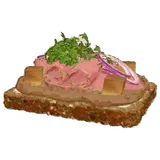
Smørrebrød
Also known as Danish open sandwich
On the record since 1888. Uncontested: Copenhagen, Denmark takes the credit.
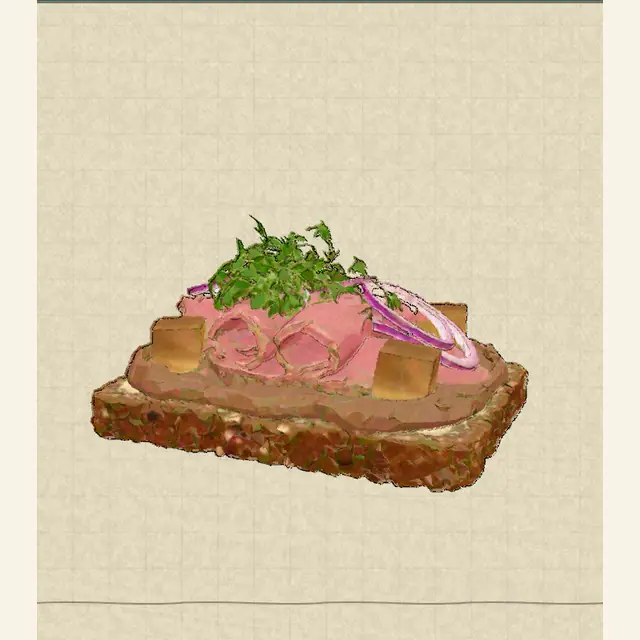
Medium confidenceAnatomy of the Smørrebrød
Origin story
Copenhagen, Denmark · 55.68°N, 12.58°E
Not invented so much as formalised.
Not invented so much as formalised. Nineteenth-century Danish farmers and factory workers carried yesterday's dinner on a slice of rye that served as the plate; the trade in cold cut meats grew quickly after the French butcher Francois Louis Beauvais set up in Copenhagen in the 1840s, and by the end of the century smørrebrød was the standard Danish lunchbox. The restaurant that turned a packed lunch into a cuisine was Oskar Davidsen, opened in Copenhagen in 1888, where Petra Davidsen made smørrebrød for wine-shop customers. Their menu eventually ran to 178 varieties and something close to four feet of paper, which earned it a place in the Guinness Book of Records.
1888
Restaurant Oskar Davidsen, Copenhagen: the establishment that turned workers' lunch into a restaurant form [1]
Our reconstruction
Notes on this reconstruction
Smørrebrød is a format, not a recipe, so any single reconstruction is a choice among 178-plus. We give dyrlægens natmad ('the vet's midnight snack') because it is one of the named classics rather than an improvisation. Confidence is medium for exactly this reason: the format is superbly documented, this particular topping's origin is not. Two rules are non-negotiable and both are about structure: real rugbrød, and butter spread to every edge so the bread never meets anything wet. It is eaten with a knife and fork, and picking it up marks you out instantly.
- Yield
- 2 pieces
Method
Butter the rye to every edge and corner. Any bare bread will go soft and the piece will collapse under the fork.
Spread the liver pâté across the whole slice in an even layer.
Drape the salt beef over the pâté, folded rather than flat, so the surface has some height to it.
Scatter the diced aspic over the beef.
Top with onion rings and a tuft of cress: aim for something that looks deliberate, since the whole form is a visual one.
Serve cold, on a plate, with a knife and fork. Assemble no more than a few minutes before eating.
Sources
- History: Ida Davidsen (retrieved 2026-09-22) Oskar and Petra Davidsen, 1888; the 178-variety menu and Guinness record; family line to Ida Davidsen
- The Origin Story Of Denmark's Iconic Open-Faced Sandwiches: Chowhound (retrieved 2026-09-22) 19th-century farmers and factory workers; Beauvais and the 1840s cold-meat trade
- Dyrlægens natmad: Wikipedia (retrieved 2026-09-22) The specific topping reconstructed here